
Where Do Game Ideas Come From? Simple Creative Techniques That Actually Work
Where do game ideas come from? Three creative techniques, X+Y mashups, constraints and everyday observation, plus a paper prototype test to run before you code.

Published on 7 min
On this page
You are standing in the shower or waiting for a bus when inspiration strikes: a game idea that will surely captivate the world. You rush to jot it down on your phone, return to your notes two days later, and feel an immediate letdown. What looked like a stroke of genius on paper is just an attractive wrapper. There is no clear gameplay loop, no emotional tension, and no real reason for anyone to stay past the first minute.
Every game designer knows that feeling. Strong game ideas rarely arrive fully formed. They are the product of a deliberate, repeatable process. In this guide, we break down three practical creative techniques you can apply right away, followed by a simple paper test that shows whether a concept holds up before you commit months to writing code.
Ideas do not drop from the sky: how a puzzle became Tetris
In 1984, Alexey Pajitnov, a software engineer at the Academy of Sciences in Moscow, was inspired by pentomino puzzles and decided to adapt the idea for a computer. The Elektronika 60 terminal he worked on had no graphics, so every piece had to be drawn with text characters. Pajitnov reduced the set from twelve shapes made of five squares to seven shapes made of four squares, called tetrominoes, and made the blocks fall from the top of the screen. That is how Tetris began. It was not a mystical vision. It was a familiar puzzle colliding with the limits of the hardware.
That is great news for any game designer. If compelling ideas come from a process, that process can be practiced and mastered. You do not need innate brilliance; you need repeatable habits.
Technique 1: X + Y - colliding two familiar worlds
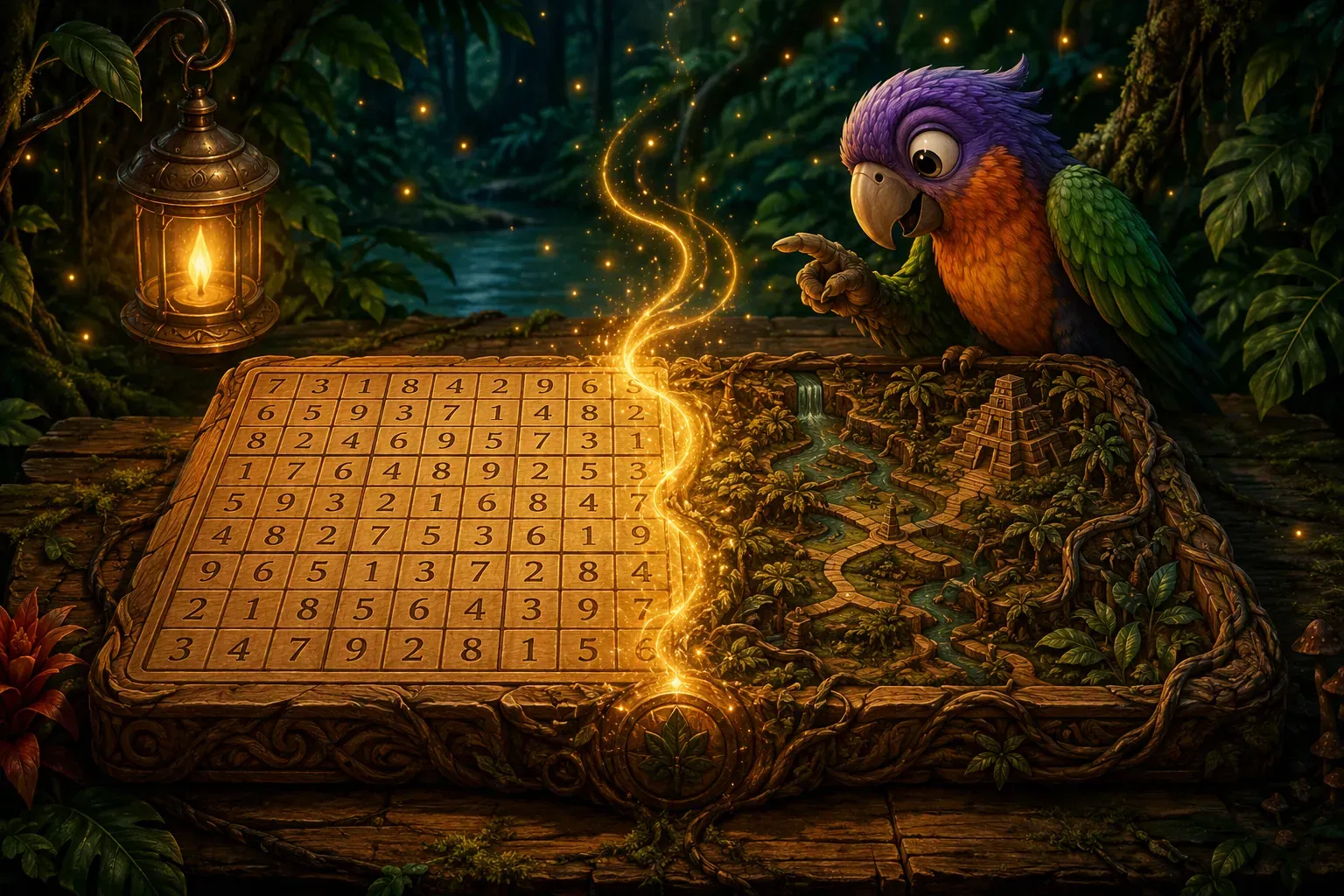
Take a core mechanic that players already understand intuitively and place it in an unexpected setting. That friction between the familiar and the unfamiliar is often what creates an irresistible hook. Moving classical sudoku into a vivid jungle expedition is the foundation of our debut project, Polydocu. You do not have to reinvent the wheel. You take a proven interaction and ask: what if clearing each grid meant taking the next step into an ancient temple?
This hybrid approach has a long tradition in game development. Participants in Ludum Dare game jams regularly cross genres that seem mutually exclusive. When Will Wright designed SimCity, he drew on two very different sources: the mathematical models of urban growth in Jay Forrester’s Urban Dynamics, and a story from Stanisław Lem’s The Cyberiad in which the constructor Trurl builds a miniature city, complete with inhabitants, for a deposed tyrant. The collision of systems engineering and fairy-tale fiction produced a game that defined an entire genre of city simulators.
How to practice it
Open a blank document and create two distinct columns:
- On the left, list mechanics that give you pure satisfaction (for example: grid deduction, precise platforming jumps, line clearing, turn-based resource trading).
- On the right, list vivid settings or themes (for example: a rainy jungle, a midnight mail train, a busy restaurant kitchen, an antique market).
Pair one item from the left with one from the right. Then ask a single key question: where in this combination does the player’s most important decision lie? If you can describe that choice in two clear sentences, you have a solid starting point for a prototype.
Technique 2: Constraints - one button, one color, 60 seconds
A blank screen is paralyzing. Total creative freedom is in fact the most dangerous trap, because it leads to chaos and a scope that keeps growing. Instead of asking “what game would be cool?”, set firm boundaries: “what satisfying mechanic fits into a single tap?” or “what can a player achieve if a whole round lasts exactly 60 seconds?”.
Gaming history shows that the most durable solutions come from limitations. Gunpei Yokoi, the Nintendo engineer behind the Game Boy, built his approach around what he called lateral thinking with withered technology: instead of chasing expensive components, he used cheap, proven parts and found new uses for them in play. The monochrome Game Boy beat color competitors such as the Sega Game Gear and the Atari Lynx, because long battery life and clear gameplay mattered more than pixels.
Josh Wardle showed a similar power of constraints with Wordle. His rule was strict: one word per day and six guesses. Being unable to play endlessly turned the puzzle into a shared daily ritual for millions of people around the world. Constraints do not choke creativity. They give it solid walls to bounce off.
How to practice it
Enter a weekend game jam or run your own 48-hour sprint with two uncompromising rules, for example one-finger controls and no text on screen. Build the simplest version that tests whether the basic action is enjoyable.

Technique 3: Everyday observation - capture details before they fade
Experienced creators do not wait for inspiration in a closed room. They look for systems and relationships in ordinary situations. Shigeru Miyamoto explained in Nintendo developer interviews that the concept for Pikmin grew out of watching ants in his garden. Earlier, his childhood expeditions into local caves became an inspiration for the exploration in The Legend of Zelda.
Building this habit requires nothing more than a notebook in your pocket or a notes app on your phone. Pay attention to everyday details:
- how people pass each other in a narrow subway corridor,
- the small tension of squeezing a bag into an overhead bin,
- the ritual of sorting coins or spices by color and size.
Each of these situations contains a ready-made dynamic: a goal, an obstacle, and a rule of behavior. The difference between someone who complains about a lack of ideas and someone who has plenty comes down to whether they write down small observations right away, before they fade.

Before you write code: a paper prototype and a three-person test
You have an idea you are excited about. The most common mistake beginners make is firing up a game engine straight away to write code and make art. That is the quickest way to waste weeks on a weak concept.
Rule number one: your first prototype must be crude, even ugly. As Jesse Schell points out in The Art of Game Design, attractive visuals can hide weak mechanics. Slick animations and a catchy soundtrack create the illusion of a good game even when the core decision loop is dull.
Grab graph paper, a handful of coins, dice, and hand-cut tokens. If the core loop cannot hold someone’s attention across a kitchen table, no shader or 3D model will save it on a phone screen.
How to run the test
- Explain the rules once, then stay quiet. Resist the urge to hint or add rules on the fly. When a player downloads your game from a store, you will not be standing behind them to explain the details.
- Watch the reactions without speaking. Notice the moment a player gets lost, the moment they reach for their phone out of boredom, and the moment they ask on their own: “shall we go again?”.
- Close with one question: “Would you play this again tomorrow?”. Avoid “did you like it?”, because most friends will say yes out of politeness.
Frequently Asked Questions
Can I test a game idea if I do not know how to program?
Yes, and you probably should. Paper, index cards, and dice are more than enough to test almost any turn-based, card, or puzzle mechanic. If the game is dull on paper, the problem lies in the core design, not in your technical skills.
How many variations of an idea should I sketch out?
Aim for at least a dozen different angles. The first three or four ideas are usually obvious clichés that everyone would think of. Going past those is what leads to distinct, memorable mechanics.
Does a mobile game need a simple premise?
It needs an intuitive, immediate entry point, but it should hide systemic depth underneath. A good rule of thumb: if explaining your core mechanic takes more than two sentences, the design is not focused enough yet.
Recommended reading: why simple game mechanics outlast their graphics, games made by one person, 7 rules for mobile game UX design, market trends in mobile puzzle games, and how to play sudoku, step by step.
Written by the team at Psittacus Studio, the makers of Polydocu, a sudoku adventure through the jungle.
Your next idea starts with a mechanic you already know
Polydocu takes a familiar mechanic, sudoku, and places it in a jungle expedition: the X+Y idea from this guide, put into practice. Join the waitlist to see how it plays at launch.
One email at launch, no spam.