Snake, Angry Birds, and the Parrot Who Could Count to Six
Snake, Angry Birds, Candy Crush and Flappy Bird: how four simple mobile games built the pocket jungle, and why parrots play exactly the same way.

Published on 10 min
On this page
Do you remember the unmistakable sound of a pixelated snake crashing into its own tail on a monochrome Nokia screen? Or the urge to immediately hit “try again” after a slingshot bird misses the target by a fraction of an inch? We return to these games years later for a reason: titles like Snake and Angry Birds share an elegant simplicity that invites you back again and again. That same philosophy guides our work at Psittacus, where we build puzzle games designed to engage your mind without artificial barriers.
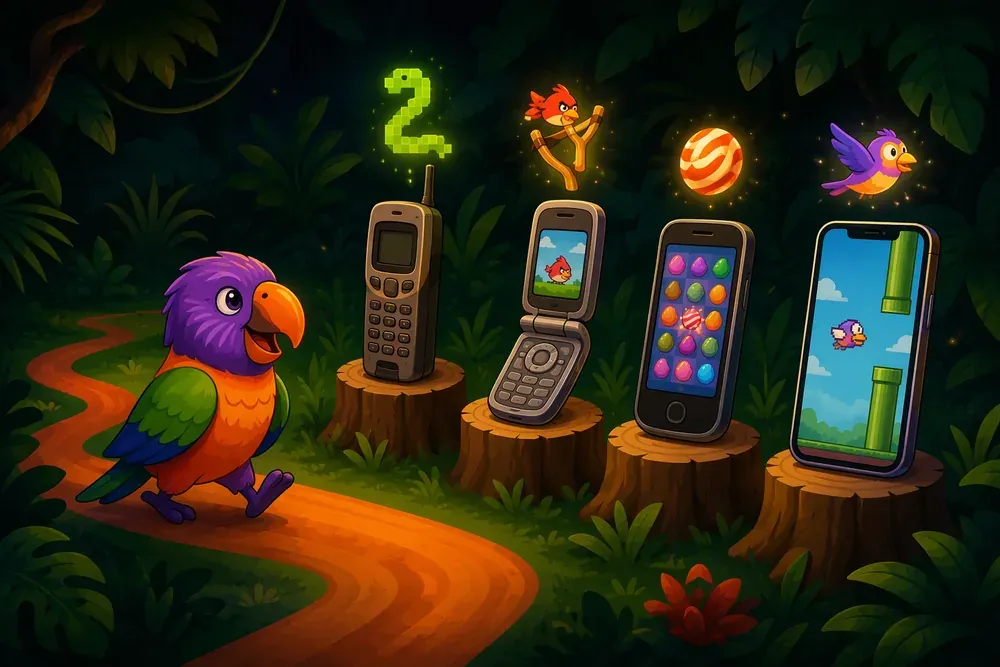
Four games that changed the pocket jungle
None of them had an AAA budget. Each one changed the industry.
| Game | Year | What it changed |
|---|---|---|
| Snake | 1997 | A phone could ship with a game built in, not bundled after the fact |
| Angry Birds | 2009 | A small paid app could reach a billion downloads |
| Candy Crush Saga | 2012 | Freemium turned waiting into a product |
| Flappy Bird | 2013 | One rule and a few days of work could reach the whole world |
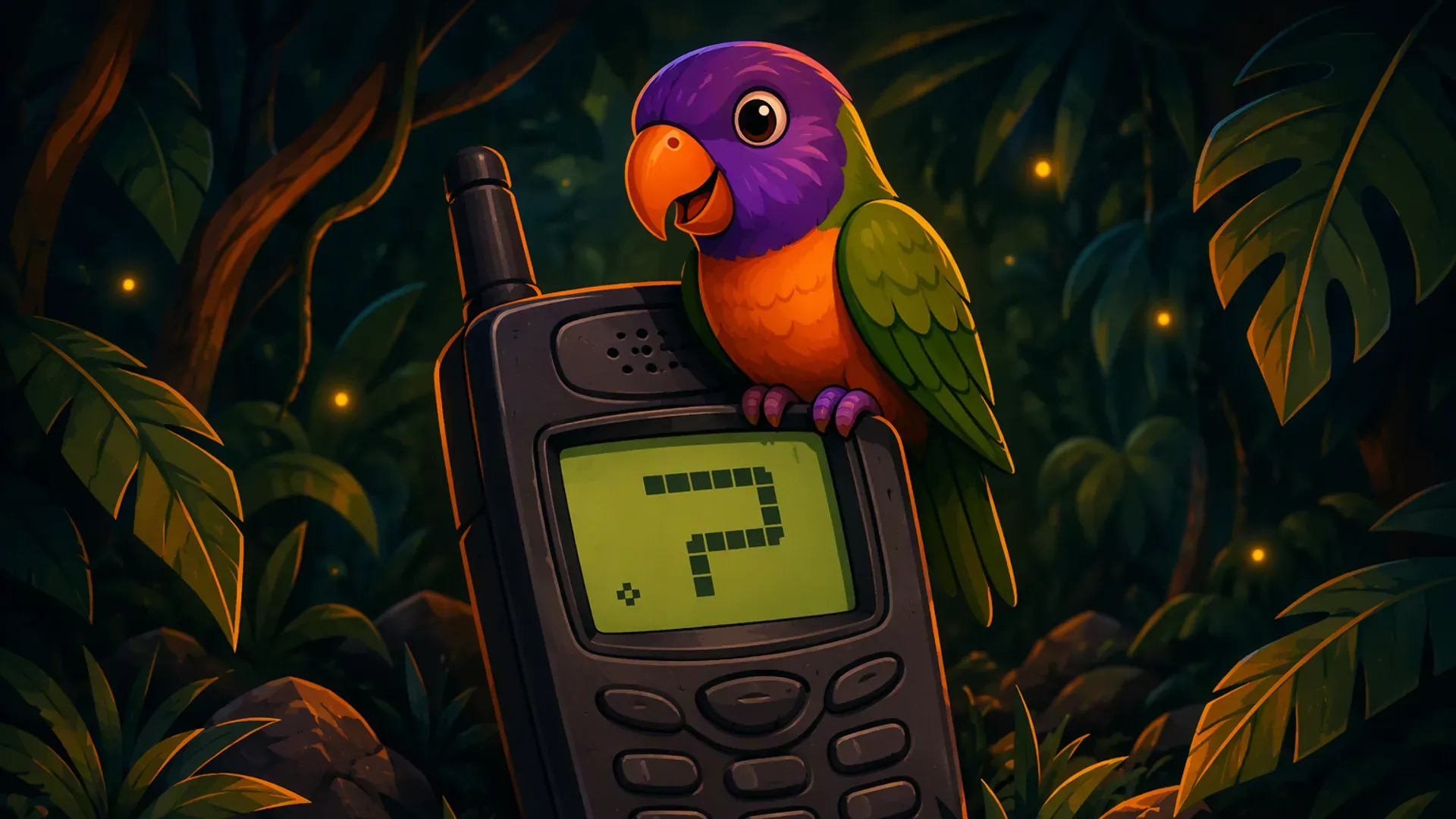
Snake (1997) exists because Taneli Armanto, a Nokia interface engineer, was told by the marketing team to add “some cool little games” to a new phone. Armanto first built a Tetris prototype, but the Tetris Company wanted a cut of every handset sold and Nokia refused to pay per unit. The snake was plan B. The result: a game shipped on hundreds of millions of phones (Nokia itself estimated 350 million copies in various forms), and in 2012 MoMA in New York added Snake to its collection of electronic art. All of it on a phone with one megabyte of memory and a monochrome screen.
Angry Birds (2009) is the story of attempt number 52. Finnish studio Rovio was close to bankruptcy when its 52nd game landed on the iPhone. In eight months they built a title that by 2012 became the first mobile game in history to reach one billion downloads. Ten years later the Rovio catalog passed 5 billion downloads.
Candy Crush Saga (2012) carried the freemium model from Facebook to phones and made paying to pass a hard level feel normal. At its peak King earned about a million dollars a day, and by September 2023 the whole franchise had passed $20 billion in lifetime revenue. Players have left 73 billion hours inside it.
Flappy Bird (2013) is the strangest of the four: an unassuming little game from Vietnam, written in a few days, earning $50,000 a day from ads. On 10 February 2014 creator Dong Nguyen pulled it from the stores, telling Forbes it had become “an addictive product” and that he could not sleep. Phones with the game still installed showed up on eBay for $1,499 and more.
Four different games, four different fates, one shared pattern: you can explain every one of them in a single sentence.
Why simple games win
Psychology offers three answers. First, flow: the challenge grows at exactly the same pace as your skill, so the brain is never bored or panicked. Second, the instant reward loop: you touch the screen, something happens, the score climbs. That short distance between action and effect feeds dopamine more often than any story-driven game. Third, variable reinforcement: unpredictable but frequent rewards hit the brain harder than certain ones. It is the same mechanism that makes us open loot boxes and check whether anyone liked our photo.
Parrots play by the same rules. The kea, a mountain parrot from New Zealand, has a call that researchers describe as contagious laughter: hearing it makes other kea start playing. It is the first documented case of an emotion spreading through a group in a non-mammal. Kea play for the sheer joy of it, tossing objects to each other and messing with tools, and a kea named Bruce, missing the upper beak, worked out how to preen with small pebbles balanced on the tongue. Play, experiment, curiosity. Evolution reached the same conclusion as game designers: the best entertainment rewards curiosity instead of punishing it.
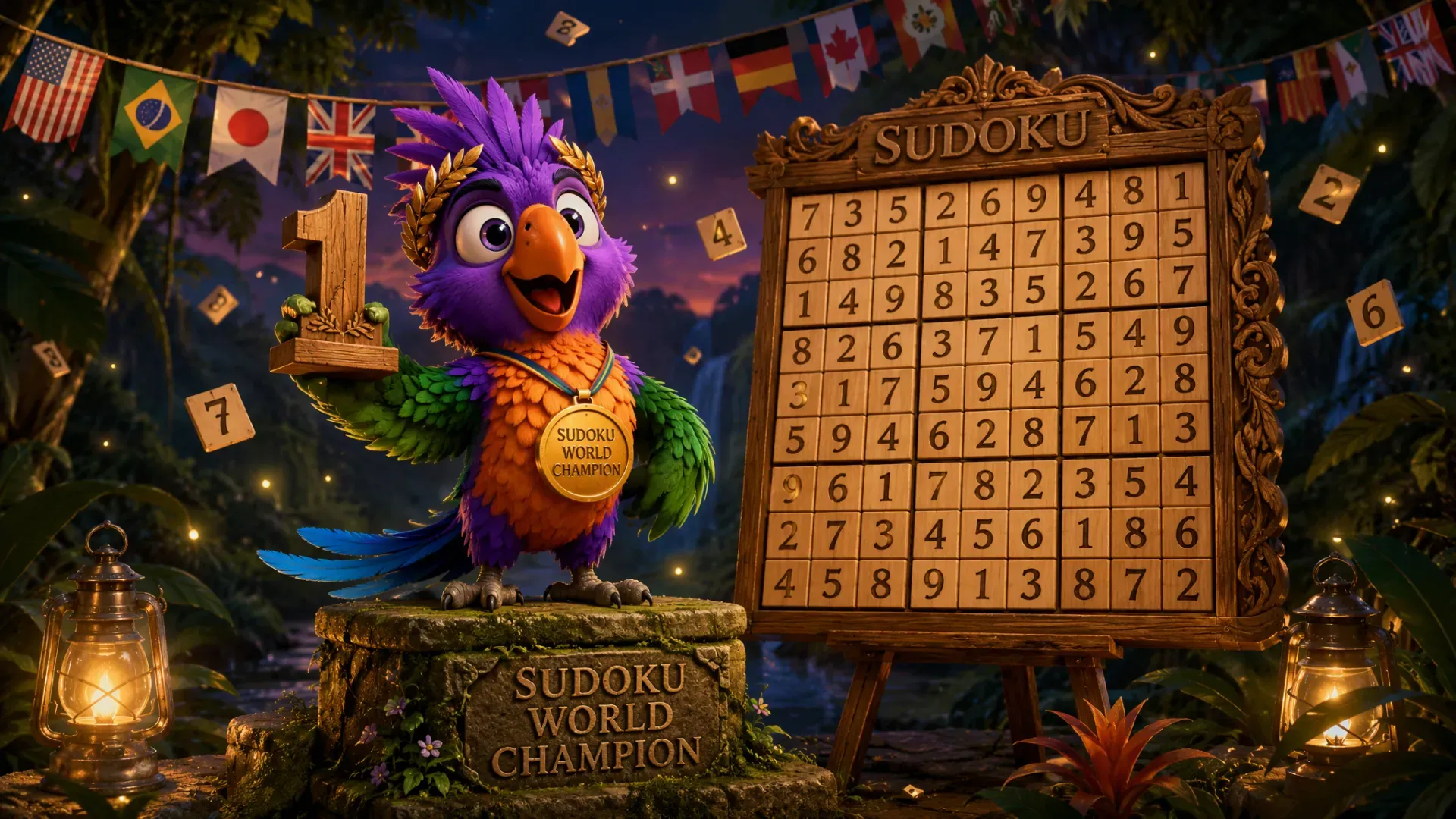
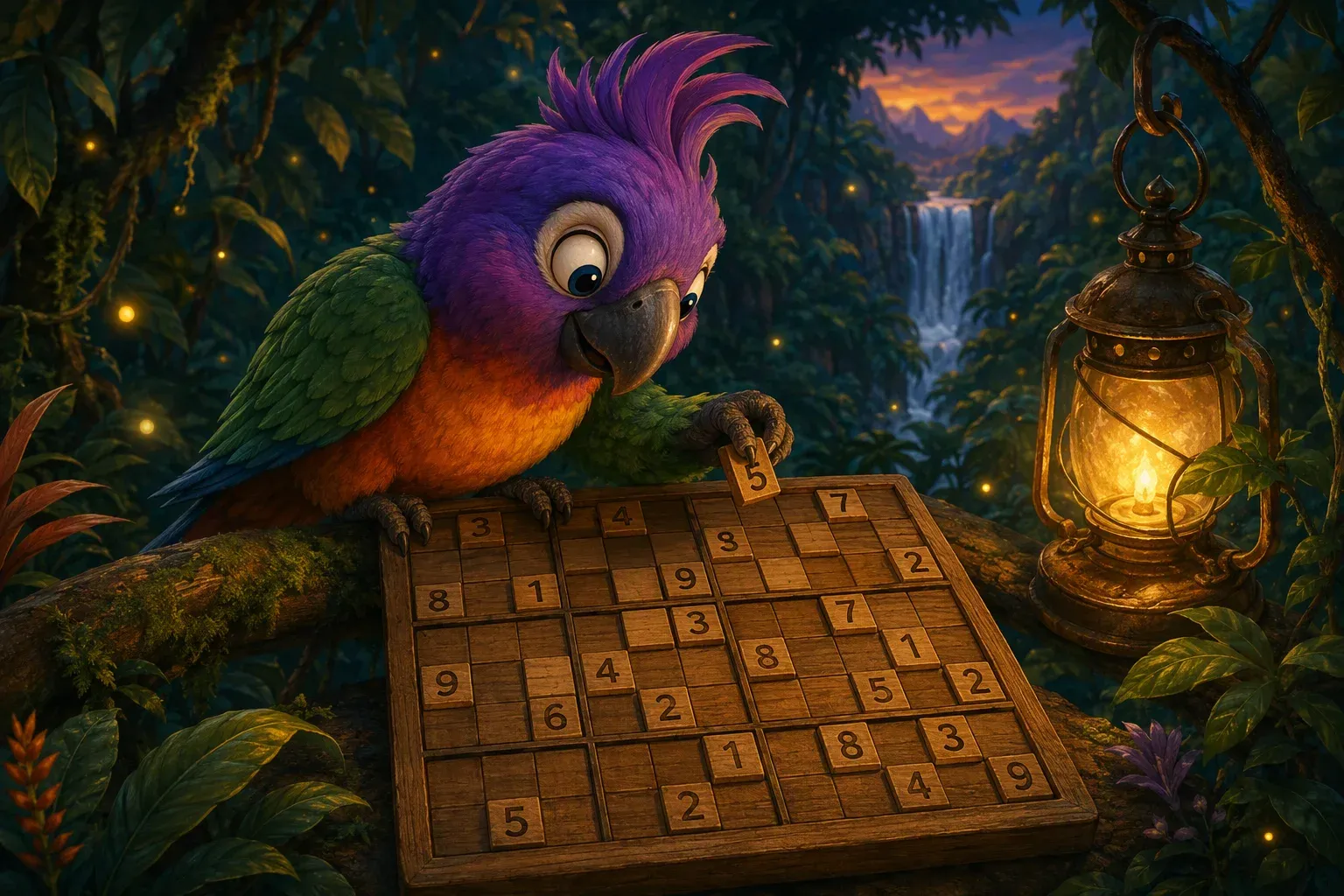
That is why in our first game, Polydocu, the sudoku takes a minute to learn and the depth lives around the board: an adventure map, daily quests, leaderboards. Nothing shows that formula working better than our scorekeeper Poly, a parrot who counts stars better than most players.
Fifteen years in your pocket: how mobile games changed
The scale of the shift is staggering. According to Newzoo, the global games market closed 2025 at $201.6 billion, with mobile responsible for $113.3 billion, more than PC and consoles combined. For 2026 the mobile forecast is $121.1 billion and 3.1 billion players, which makes mobile 84% of everyone who plays games on Earth.
What changed even more than the money is how games earn it. The Snake era was hardware sold with a game inside. The Angry Birds era was a paid app for a dollar. The Candy Crush era was freemium, where you play for free and pay for patience. Over the past fifteen years the market has come full circle: today the cost of acquiring a player keeps rising, so the old question comes back again and again, whether the best monetization is simply a game people want to return to. That is the philosophy we wrote into the four rules of Psittacus from day one: simple at the core, rich around it, player-first, crafted with care.
The games we return to: the mechanics of nostalgia
Nostalgia in games is no longer just a feeling, it is a researched phenomenon. A 2024 review in Current Opinion in Psychology describes games as “digital time machines”: worlds that did not age along with us and wait, untouched, exactly where we left them. Researchers distinguish personal nostalgia, for our own memories, from historical nostalgia, for an era we never knew. Snake works on both fronts: personally you remember your own record, and historically it is now an exhibit in the Museum of Modern Art.
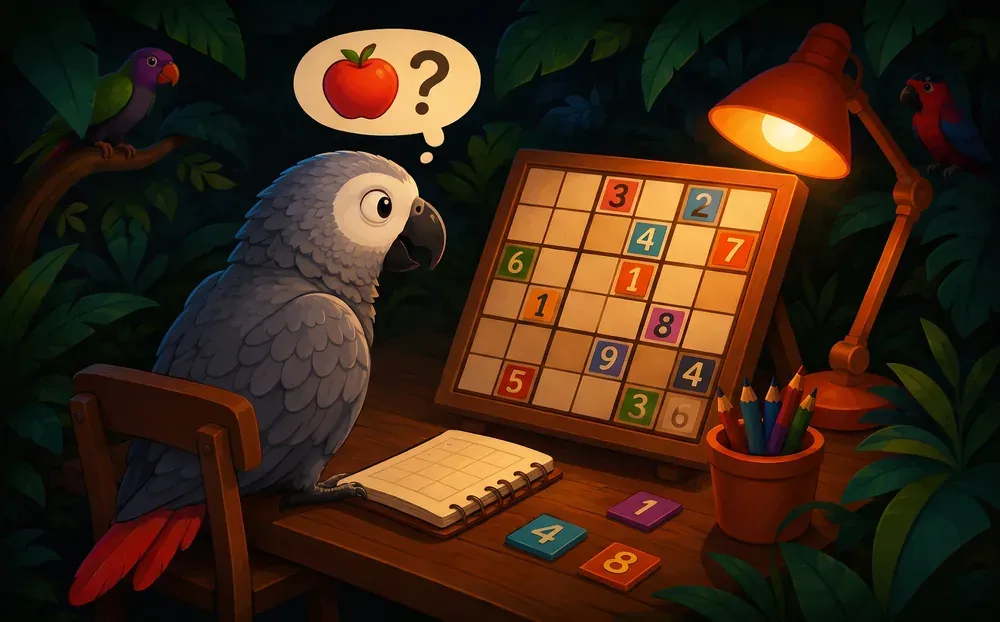
The parrot explains why. The grey parrot, the bird our studio is named after, lives up to 80 years in the wild and covers up to 35 miles a day, yet it always comes back to its flock and its favorite places. The most famous grey parrot, Alex from Irene Pepperberg’s lab, understood the concepts of “bigger”, “smaller”, “same” and “different”, counted to six, and grasped the idea of zero. When he saw an apple he had never seen before, he called it “banerry”, blending “banana” and “cherry”. A player who looks at Candy Crush and sees “Tetris, but sweeter” does exactly the same thing: translating the present into a language they already know. Nostalgia is not going backwards. It is translating. If you want to see how such simple mechanics are born, read where game ideas come from.
Why Snake still works: the anatomy of a simple game
Let us take the snake apart and count what it needs.
One goal: eat the dot. One rule: do not hit the wall or yourself. One loop: action, score, restart in under a second. The rising difficulty comes out of the mechanic itself, because every eaten dot lengthens the snake and narrows the field. Zero tutorials, zero loading bars, zero coins. Armanto summed it up in a sentence that should hang on every studio wall: there is no point using complex solutions when simple does the job.
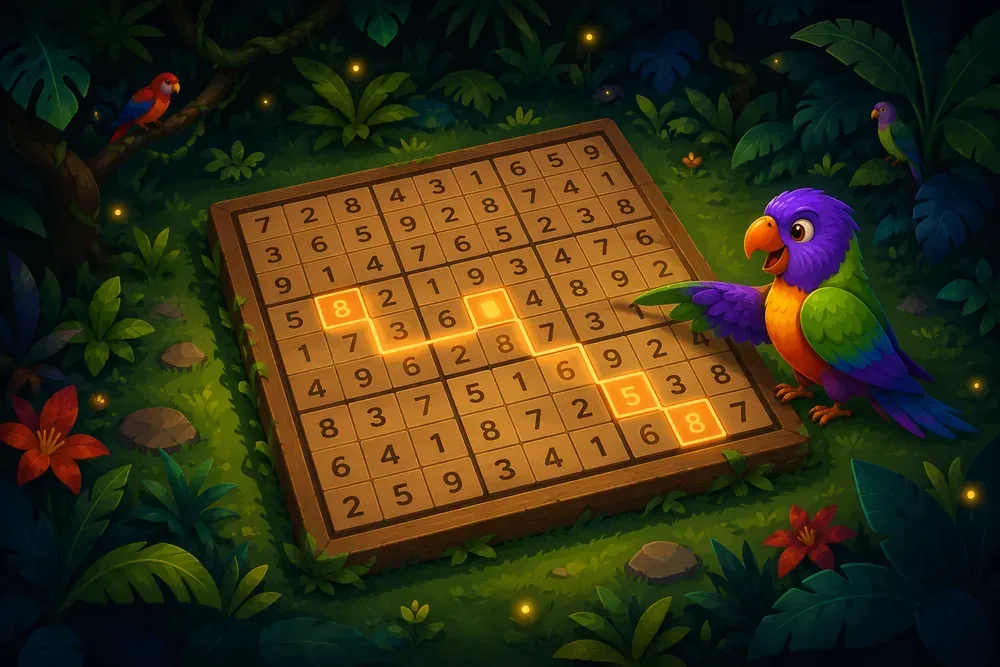
This anatomy has not aged in a quarter century because it was never fashionable. It was good. At Psittacus we take it literally: if a mechanic needs an instruction page, it is not finished. The sudoku board in Polydocu is our dot to eat: one rule, understood at a glance, and everything around it, the map, the quests, the seasons, is jungle growing around a simple truth.
Parrot facts for dessert
Notable facts about parrots
To round things out, here are a few verified facts from the world of avian cognition:
- The genus name Psittacus was established by Carl Linnaeus in 1758 in Systema Naturae. Today, it primarily represents the African grey parrot (Psittacus erithacus).
- The name traces back to ancient Greek ψιττακός, recorded in antiquity to reflect the bird’s distinct vocalizations.
- Parrots possess a unique class of feather pigments, psittacofulvins, found in no other birds, which gives their plumage its vivid coloration.
- Alex the grey parrot understood around 100 words and could ask logical questions.
- In the wild, many parrot species regularly use tools, and urban cockatoos have been documented learning complex problem-solving from their peers.
Frequently asked questions
What was the first widely known mobile game?
Snake, created by Nokia engineer Taneli Armanto and launched on the Nokia 6110 in 1997. Nokia estimated over 350 million installations worldwide, and in 2012 the Museum of Modern Art in New York added Snake to its permanent digital design collection.
Why do simple mobile games hold attention so well?
They tap into psychological flow, where difficulty scales naturally with skill, paired with immediate feedback on every touch and the satisfaction of small, steady milestones.
How many downloads did the Angry Birds series achieve?
In 2012, it became the first mobile game to cross one billion downloads. A decade later, the entire Rovio portfolio surpassed five billion total downloads.
Why was Flappy Bird removed from app stores?
Its creator, Dong Nguyen, voluntarily pulled the game in February 2014, explaining that its runaway popularity had turned it into an uncomfortably addictive experience for many players.
See you in the game
The evolution of mobile games demonstrates that simplicity and respect for player attention outlast complex trends. Snake did not need photorealism and Angry Birds did not need an elaborate narrative to win over millions. We revisit them because well-crafted mechanics age far slower than visual styles.
That is why Polydocu is centered around classic sudoku set against an inviting jungle adventure. We have taken care to ensure the board is clear, comfortable for one-handed play, and accessible for players with color vision deficiency, as detailed in our accessibility guidelines. If you would like to be among the first to play, join our waitlist. We will notify you when the game launches on iOS and Android.
Related reads: explore market trends in mobile puzzle games, discover how indie devs build hit games alone, and read where game ideas come from.
Sources and further reading:
- MEL Magazine: An Oral History of Snake on Nokia
- Wikipedia: Snake (1998 video game)
- Rovio: our history
- Rovio: 5 billion downloads
- Game World Observer: Candy Crush Saga crosses $20 billion
- Business of Apps: Candy Crush statistics
- Wikipedia: Flappy Bird
- ABC News: Flappy Bird creator on addiction
- Newzoo: 2025 games market
- Newzoo: 2026 key numbers
- ScienceDirect: Nostalgia in video games (review)
- The Conversation: the psychology of video game nostalgia
- ScienceDirect: Pepperberg, cognitive and communicative abilities of grey parrots
- National Geographic: contagious laughter of kea
- Science News: what parrots teach us about intelligence
- Wikipedia: Psittacus genus
- Molecule of the Month: psittacofulvins
Timeless gameplay that never goes out of style
The most memorable mobile games succeed through clear, elegant mechanics. Polydocu pairs classic sudoku with a rich jungle adventure and zero artificial paywalls. Join the waitlist today.
One email at launch, no spam.