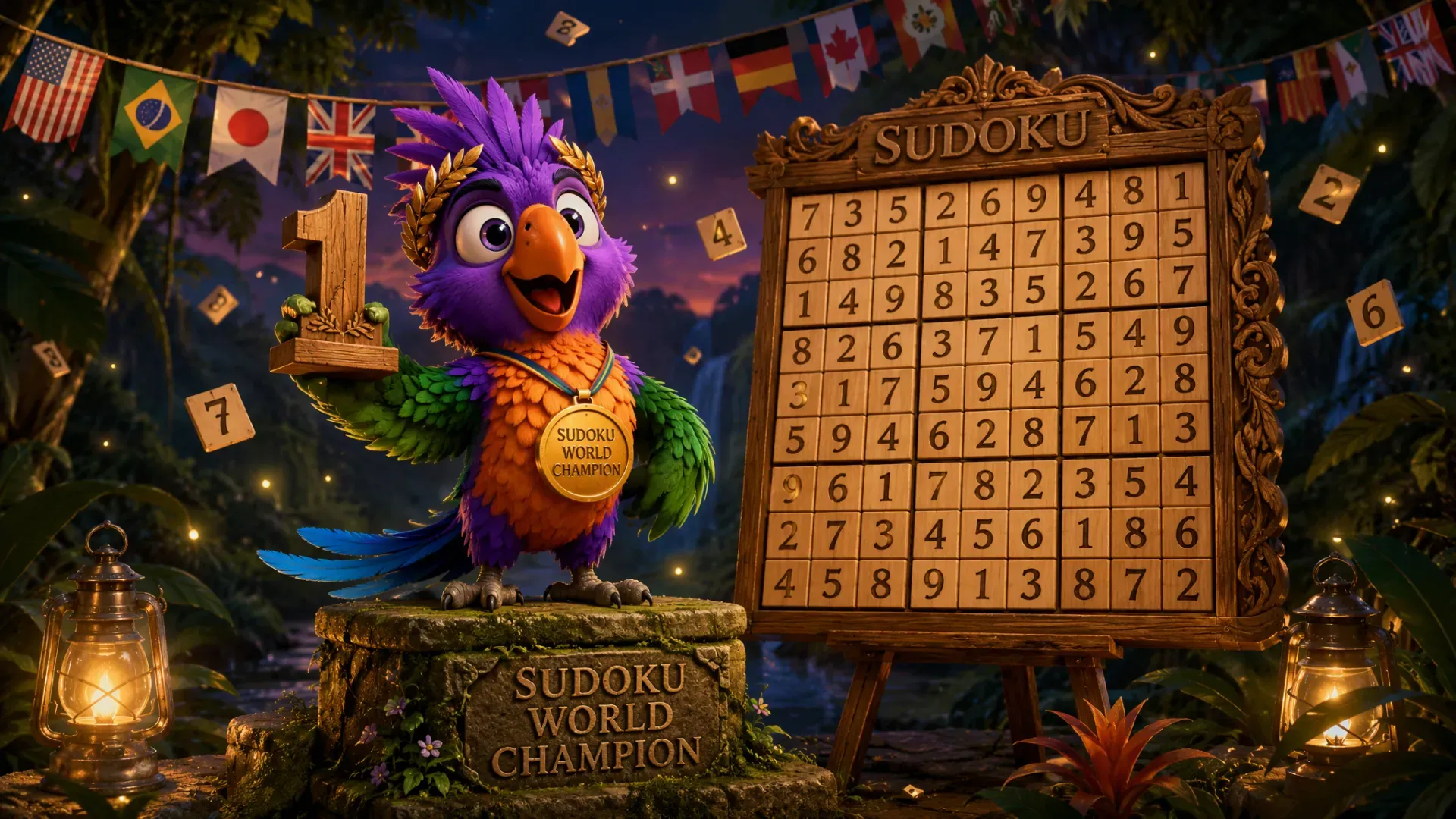
World Sudoku Championships and the People Behind the Puzzle
From the World Sudoku Championship in Krakow to the first sudoku TV show. Meet the players, puzzle makers and the story behind the grids.

Published on 10 min
On this page
Eighty-one cells, nine digits and one rule. From these simple parts came one of the great hobbies of the 21st century. In 2018, fourteen-year-old Wang Shiyao of China filled an entire grid in 54.44 seconds. Other players train for years before they enter their first tournament.
Behind the game are people: a retired Hong Kong judge who offered puzzles to newspapers for free, and a Japanese publisher who came up with the name just before a horse race. A Polish player, meanwhile, won the individual world title three times. You will not find these stories in the rules, but they help explain why sudoku still draws players despite the flood of newer puzzle games on phones. If you want the origin story first, read our article on the history of sudoku from 1895 to today.
The World Sudoku Championship: a contest against the clock
Since 2006 the World Puzzle Federation has organized the World Sudoku Championship. The first edition took place in Lucca, Italy, and the title went to Jana Tylová of the Czech Republic. The field has grown since then, led by players from China, Japan, the Czech Republic and Estonia. The full list of champions and host cities shows how the event has travelled: Prague, Goa, Zilina, Philadelphia, Beijing, London, Sofia, Senec, Bangalore, Toronto and, in 2025, Eger in Hungary once again.
How the tournament works and how fast the best play
The championship runs over two days and a dozen-plus rounds. Players solve classic grids and variants, from the standard 9x9 to killer and odd-even puzzles. Each round has a strict time limit, and points depend on accuracy as well as speed. National teams of three or four players qualify through their own national championships.
The best players set a remarkable pace. Thomas Snyder, an American biomechanics researcher, has held a Guinness World Record since 2006 for finishing a “very easy” grid in 1 min 23.93 sec. He also holds the record for an “easy” grid in 2 min 8.53 sec. Both times were set on paper, with no hints and no borrowed numbers.
The tournament record is even more striking. In November 2018, at the World Sudoku Championship in Prague, fourteen-year-old Wang Shiyao solved a competition grid in 54.44 seconds. A record grid has to meet strict criteria: exactly 27 givens, three in every row, column and 3x3 box. There is no room for guessing and no shortcut. She was facing a grid designed for that record, not a random puzzle.
Polish traces on the championship map
Poland has a strong record in the championship’s history. Jan Mrozowski won the individual title three times: in Zilina in 2009, in Philadelphia in 2010 and in Kraljevica, Croatia, in 2012. The titles were not consecutive, because Thomas Snyder won in 2011 in between. Mrozowski remains one of the most decorated players in the event’s history.
Poland has also hosted the championship. In 2022 Krakow welcomed competitors from around the world, and Estonian solver Tiit Vunk took the individual title. The domestic scene has long been supported by the Sfinks Foundation for the Development of Recreational Mathematics. The foundation runs the Polish Sudoku Championship, and its winners advance to the world championship. Lower Silesia alone has drawn more than 4,000 students from over 100 schools to its qualifiers. That shows sudoku is not a hobby for a chosen few. Anyone can try it.
China has led the recent years. Ming Letian won in Beijing in 2024, and Dai Tantan took the 2025 title in Eger, a trend also visible in the WPF Grand Prix standings. Today’s top players are often young people for whom sudoku is a sport rather than a way to pass the time on a journey.
Why newspapers fell in love with sudoku
Sudoku did not conquer the world online. It conquered print. Long before apps and leaderboards, newspapers carried the puzzle, and one idea made that possible. Wayne Gould, a New Zealander and retired judge in Hong Kong, wrote a program that generated puzzles and offered them to editors free of charge. In return he asked only for a byline and a link to a page with the solutions.
The effect came quickly. In September 2004 the small Conway Daily Sun of New Hampshire became the first newspaper outside Japan to publish a sudoku. Two months later, on 12 November 2004, The Times of London launched its own. The first reader letter arrived the next day. Ian Payn of Brentford wrote that the puzzle had absorbed him so completely that he missed his stop on the Tube.
That anecdote shows the power of the game. Sudoku needs no language, no dictionary and no encyclopedia. A pencil and a quiet moment are enough. For newspapers it was ideal material: a puzzle that a reader of any age, in any country, could solve on the way to work. Through 2005 British papers joined one after another, and the BBC even developed a TV format around the puzzle. By mid-2006 nearly every major American daily printed a daily sudoku, and Gould’s software supplied more than 400 newspapers around the world.
Japan followed a different path, for a different reason. Word crosswords fit poorly with a writing system that uses thousands of kanji, so a clean grid of digits was a natural choice. Japan still sells more than 600,000 sudoku magazines every month. Newspapers came to love sudoku because readers loved it first, and that affection has lasted.
Sudoku in pop culture: TV, books and games
A game you can explain in one sentence turned out to suit the screen well. In July 2005 the British channel Sky One aired Sudoku Live, the first television programme devoted to sudoku. Carol Vorderman presented it. Nine teams of nine players competed for prizes, and viewers at home could play along through an interactive platform.
The BBC went further and combined the grid with quiz questions. SUDO-Q, hosted by Eamonn Holmes, mixed 4x4 and 6x6 sudoku with general knowledge, with 2,000 pounds on offer. It ran from December 2005 to March 2007. A puzzle in the prime-time schedule of a national broadcaster shows how far sudoku had moved into everyday life.
The video game market picked it up just as quickly. There were console and PC versions with Carol Vorderman as the expert, and a sudoku minigame in Nintendo Brain Age, one of the best-selling series of that decade. Sudoku also reached books. In The Sudoku Murder by Shelley Freydont the puzzle sits at the centre of the plot, and sudoku songs appear in studies of popular culture. The game had become a symbol of cleverness and calm challenge, not just a grid of numbers.
There were stunts too. In 2005 an 84-metre sudoku was cut into the grass of a hill at Chipping Sodbury in England, and Radio Times printed 16x16 “Super Sudoku” grids. Today the culture lives on smartphones, but the appeal is the same: sudoku looks good in a photo, is easy to talk about, and fills any spare moment.
Puzzle constructors: a job born with the game
Behind every good grid stands a person or a program. The job of puzzle constructor took shape in Japan, at the publisher Nikoli. In the 1980s Nikoli set standards that still separate a good sudoku from a random grid: a symmetrical pattern of givens, a lean set of starting digits and, above all, a single solution that logic alone can reach, without guessing.
A constructor works backwards. They begin with a completed grid, remove digits, and check after each removal that the puzzle still has exactly one solution. Then they shape the solving path, so that the solver finds one key move, then the next, and finally feels the satisfying moment when everything clicks. A good puzzle is not only correct. It is also well built.
Mastery and invention go hand in hand in this field. Thomas Snyder, the Guinness record holder, is also a respected puzzle author. The constructor community around the WPF championships creates original puzzles for the tournament rounds every year. Puzzle editors, from Will Shortz to niche publishers, choose grids for their character as well as their difficulty.
If you have ever solved a sudoku that guided you through the first moves and then revealed a neat trick, you have a constructor to thank. Their choices shape the rhythm of the game.
Hand-built versus computer-generated: does the human still win?
This leads to the most interesting debate in sudoku. Mathematics shows how vast the space of choices is. Bertram Felgenhauer and Frazer Jarvis counted 6,670,903,752,021,072,936,960 completed grids. Once reflections and rotations are discounted, 5,472,730,538 remain. A computer can produce millions of valid puzzles per hour, each with a single solution.
The catch is that generating a valid sudoku is easy, while generating a good one is an art. Nikoli’s constructors build grids by hand, often over many hours, and reject puzzles that force guessing or have clumsy solving paths. Their grids have a distinctive rhythm and symmetry that software does not choose on purpose. As Sudoku Professor put it, a generated sudoku is the family station wagon, while a hand-built one is a European sports car. Both get you there, but the drive is different.
We could not find a rigorous blind test in which solvers identified a puzzle’s origin without hints. Our affection for handmade puzzles may therefore be aesthetic as much as logical.
Computers also settled a question that humans could not. In 2012 Gary McGuire, Bastian Tugemann and Gilles Civario proved that no valid sudoku has 16 clues. The minimum is 17. The proof took about 7.1 million core hours on a supercomputer in Dublin. No person could have checked it alone.
The answer is measured. Generators win on access: a daily grid in the paper, thousands of puzzles in apps, instant difficulty ratings. Humans win on ideas: grids with character and an “aha” moment worth returning for. Both have their place, and sudoku is better for having both.
What does all this mean for everyday players?
You do not need records to enjoy sudoku. It helps, though, to know where the pleasure comes from. If you like hand-finished grids, look for titles inspired by Nikoli’s Japanese school. If you prefer long sessions and many variants, apps with generators give you a large pool of puzzles matched to your level. If you enjoy competition, start with the Polish Championship, work through the qualifiers and aim for the world stage.
At Psittacus Studio we believe the best sudoku combines two things: the clean logic of a classic grid and the warmth of a game you want to come back to. That is why our parrot Poly accompanies players through jungle maps, daily challenges and leaderboards, without frustration and without artificial walls.
FAQ: common questions about sudoku, tournaments and constructors
Who invented sudoku?
The modern 9x9 layout with 3x3 boxes was designed in 1979 by American architect Howard Garns. Japanese publisher Maki Kaji gave the game its name in 1984. We cover the full story in a separate article.
Who holds the fastest sudoku times?
Thomas Snyder has held Guinness World Records since 2006 for 1 min 23.93 sec (“very easy”) and 2 min 8.53 sec (“easy”), both on paper. The tournament record belongs to Wang Shiyao, who finished a grid in 54.44 seconds in Prague in 2018.
Have Poles won the World Sudoku Championship?
Yes. Jan Mrozowski won the individual title three times, in 2009, 2010 and 2012. The championship has also been held in Poland: Krakow hosted it in 2022.
How many clues does a sudoku need?
At least 17. This is a proven result, not a conjecture: in 2012 a computer proof showed that no valid sudoku has only 16 clues.
Is it worth solving hand-built sudoku?
Yes, at least once. Hand-built puzzles, such as those from Japan’s Nikoli, often have a clearer rhythm and a more elegant solving path. Generated grids are ideal for daily practice and for fine-tuning difficulty.
Where can I find good sudoku on my phone?
Look for apps with classic rules, a readable board and honest difficulty levels. In our view, the best ones respect the purity of the game and add to it without distractions.
Polydocu - a sudoku adventure
Nine digits, an expedition through the jungle, Poly the parrot, and no artificial roadblocks. Join the waitlist and we will notify you when the game launches.
One email at launch, no spam.