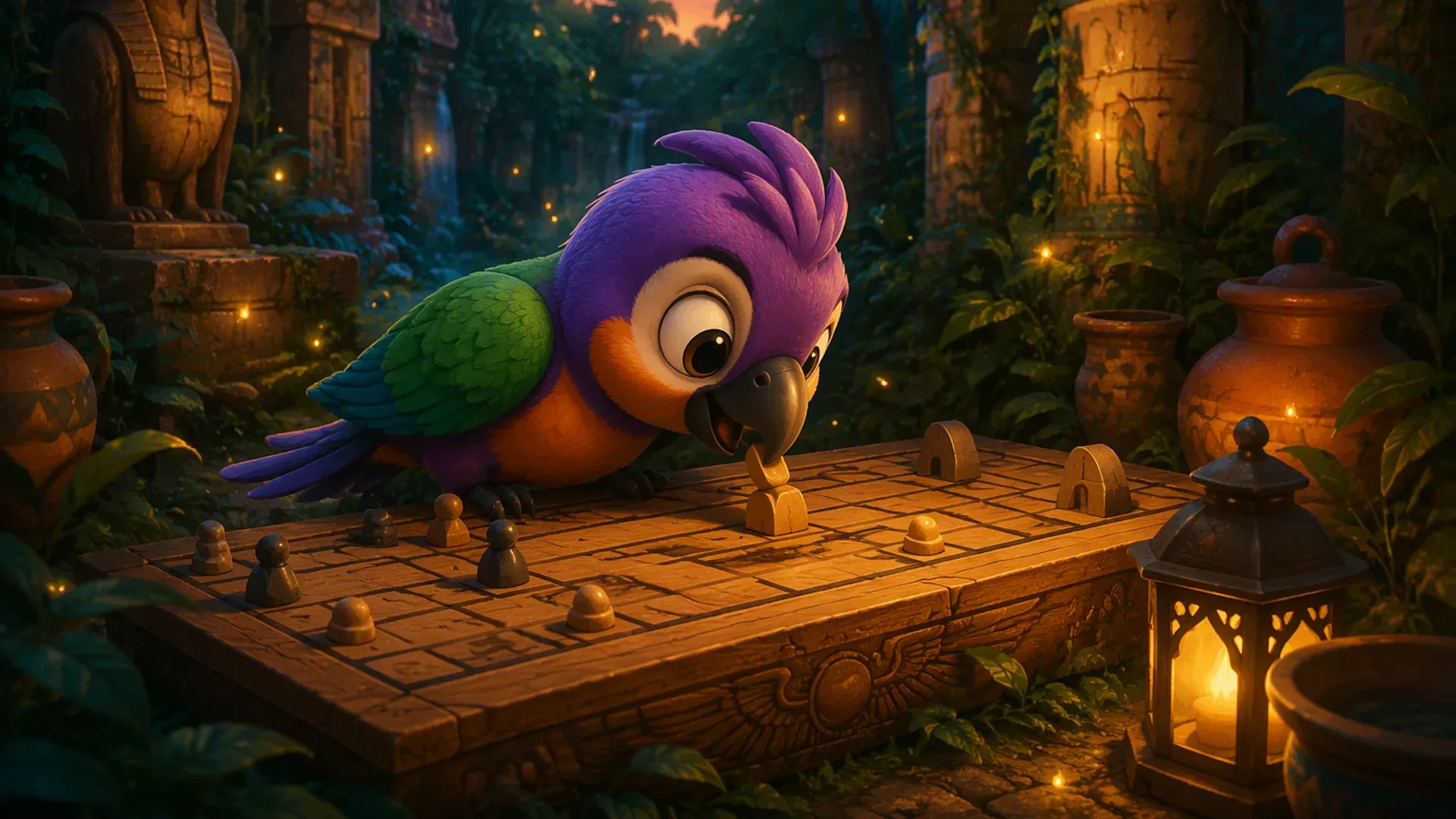
The Oldest Games in the World: Senet, Go and 5,000 Years of Simple Rules
Explore the oldest board games in history: Egyptian senet, the Royal Game of Ur, Go, and mancala. Discover their reconstructed rules and enduring design logic.

Published on 12 min
On this page
A carved wooden board, a handful of casting sticks, two players, and a quiet evening. Though separated from ancient Memphis or Ur by thousands of years, the ritual remains familiar. Today’s smartphone screen fulfills the exact same role as those antique wooden boxes: carving out a pocket of time for focus, rivalry, and puzzle-solving. Games have accompanied humanity longer than coins, alphabets, or most ancient cities.
At Psittacus Studio we design mobile puzzle games, which makes studying ancient board games feel like examining our own craft’s foundation. Every board recovered from desert sands reveals how early civilizations thought about luck, justice, and play. And because our studio mascot is Poly the parrot, this exploration includes a feathered perspective. As it turns out, the drive to solve problems and play for pure fun links birds and humans far more closely than most people realize.
Before the first boards: why do we play at all?
Play is by no means unique to humans. Throughout the animal kingdom, play sharpens reflexes, builds social bonds, and relieves tension. Yet few creatures play with the sheer enthusiasm of parrots. New Zealand’s alpine kea parrots roll snowballs down mountain slopes, playfully chase flockmates, and produce a distinct play call that researchers at the Messerli Research Institute identified as the first confirmed example of contagious positive emotion in birds: hearing it prompts other keas to drop what they are doing and join in.
Human beings took that shared instinct and gave it structure. We established formal rules, drew boundaries on boards, and carved distinct values into tokens. Over centuries, casual play deepened into cultural ritual. Throwing knucklebones around a campfire grew into an allegory for the soul’s journey, an inquiry into divine will, or strategic training for generals. That basic act of sitting across from an opponent over a shared grid has outlasted empires.
Senet: the Egyptian crossing (c. 3100 BCE)
The oldest surviving senet boards come from First Dynasty Egyptian tombs, dating to roughly 3100 BCE. They represent some of the earliest physical evidence of organized board gaming anywhere in the world. The layout was lean and purposeful: a long box containing thirty squares arranged in three rows of ten, several pawns per player, and two-sided casting sticks or animal knucklebones whose roll determined movement.
The earliest known depiction of senet appears in the tomb of the vizier Hesy-Re (c. 2620 BCE). Egyptians documented their games almost as soon as they developed writing, and senet was enjoyed across all social strata. Queen Nefertari was painted on her tomb wall playing senet on her journey toward the afterlife, while Tutankhamun was buried with four separate, exquisitely crafted game sets.
As curators at the Metropolitan Museum of Art note, senet evolved during the New Kingdom from leisure into sacred allegory. The word senet translates to “passing” or “traveling.” The race across the board came to symbolize the soul navigating the hazards of the underworld (Duat). Chapter 17 of the Book of the Dead depicts the scribe Ani playing against an invisible adversary to secure safe passage to eternity. A satirical papyrus from roughly 1250-1150 BCE (now in the British Museum) even portrays a lion and a gazelle facing each other across the board.
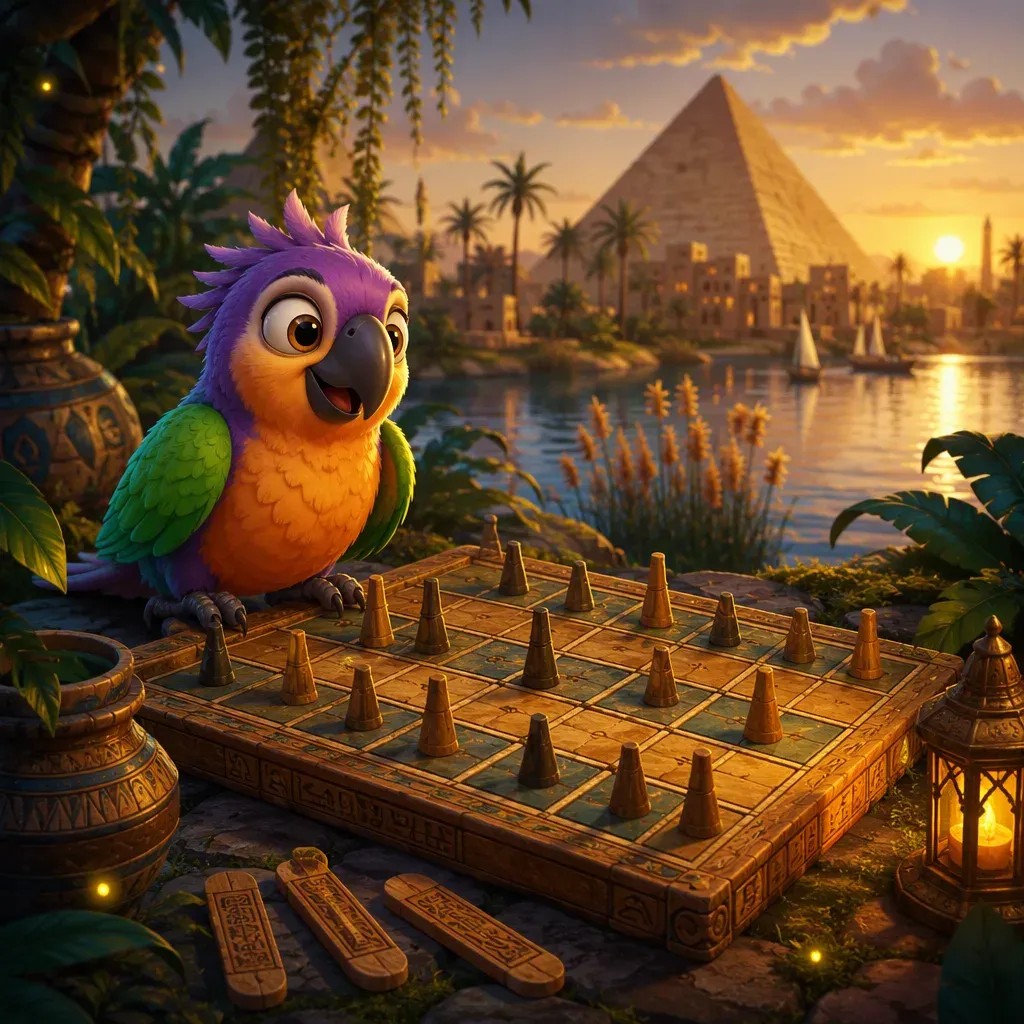
The game’s greatest mystery lies in its rules. Egyptians played senet for three millennia without leaving behind a single written rulebook. They recorded medical treatments, legal decrees, and grain tallies, but never documented senet’s mechanics: everyone already knew how to play.
Modern rules rely on archaeological reconstructions, most notably by Timothy Kendall (Passing Through the Netherworld, 1978) and British game historian R. C. Bell. Both agree that senet was an S-shaped race game where players navigated treacherous traps before bearing their pieces safely off the board. A thorough breakdown of these theories is featured on GamesFanatic.
The Royal Game of Ur: Mesopotamia’s favorite pastime (2600-2400 BCE)
While Egyptians navigated senet, Sumerians were engrossed in the Game of Twenty Squares, known today as the Royal Game of Ur. Sir Leonard Woolley uncovered breathtaking boards inlaid with shell, red limestone, and lapis lazuli during his 1920s excavations of the Royal Cemetery at Ur. Dated between 2600 and 2400 BCE, the finest specimens reside in the British Museum.
The game spread swiftly along ancient trade networks. Boards and street graffiti have turned up across modern-day Iran, Syria, Israel, and Egypt. When players lacked a wooden box, they scratched twenty squares into bricks, flagstones, or clay fragments.
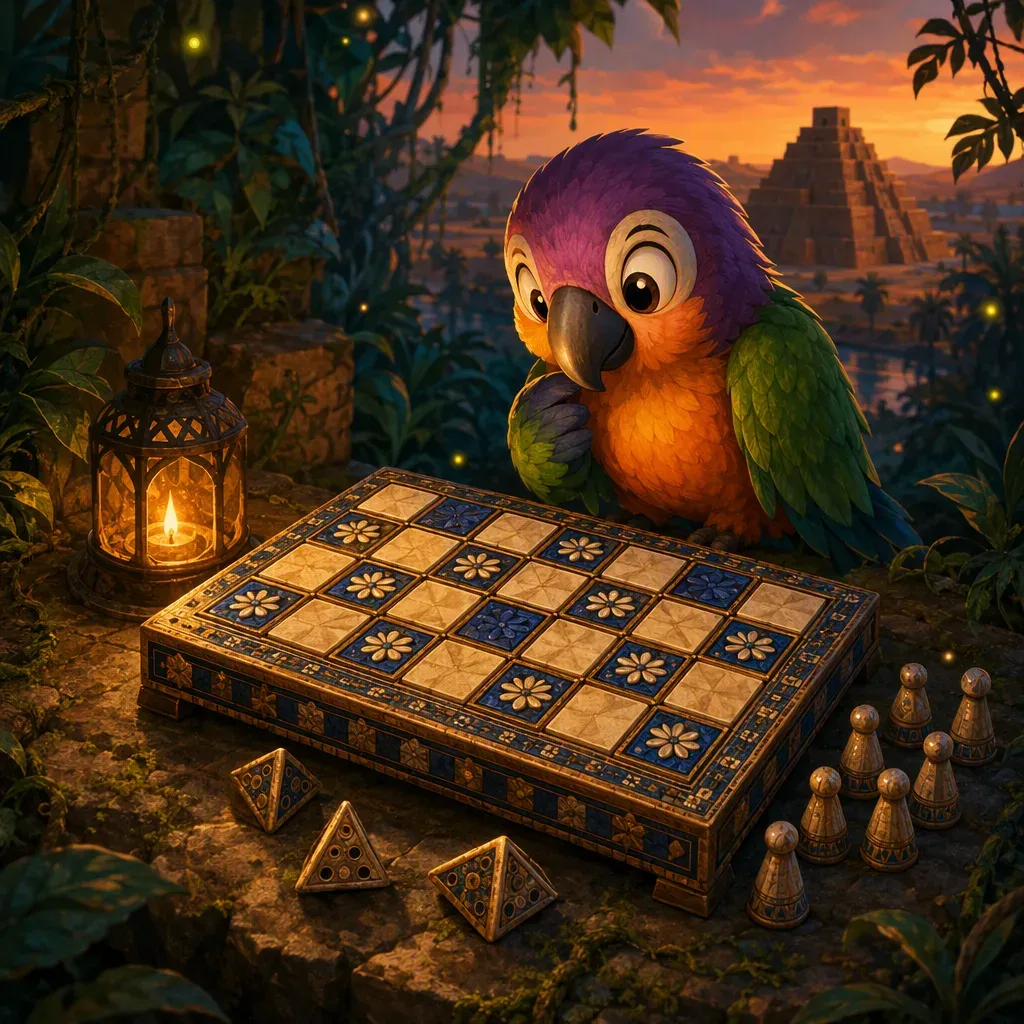
Unlike senet, the rules of Ur survived directly. In the 1980s, British Museum curator Irving Finkel translated a Babylonian cuneiform tablet written by a scribe in 177 BCE. The tablet laid out exact rules and referenced older traditions. We now know that each player commanded seven pawns, rolling four tetrahedral (pyramid-shaped) dice to navigate the board. Pieces entered via separate tracks, contested a central combat lane, and found sanctuary on squares marked with rosettes.
Wikipedia provides a clean overview of the sources and variants, and the reconstructed game can be played live at RoyalUr.net. The Royal Game of Ur dominated the ancient Near East for millennia before gradually giving way to backgammon.
Go: minimal rules, bottomless complexity (China)
Chinese tradition attributes the creation of Go (known as Weiqi) to the legendary Emperor Yao, who supposedly asked a counselor to invent a game that would teach his unruly son discipline and strategic foresight. The earliest verified written reference appears in the historical chronicle Zuo Zhuan (c. 548 BCE), and Confucius cited Go in the Analects as a pursuit worthy of an educated gentleman.
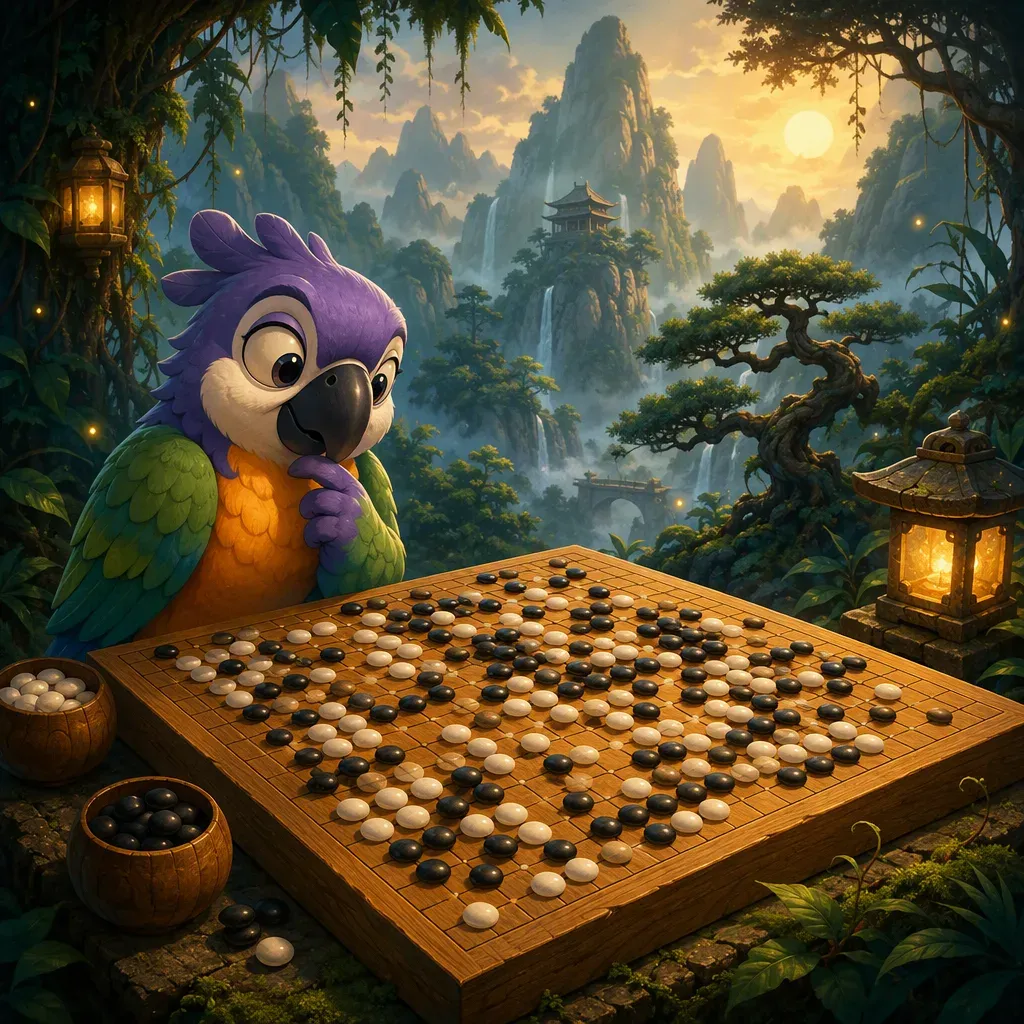
The earliest physical board fragments date to the Western Han dynasty (c. 200 BCE), as detailed in archaeological research compiled by BabelStone. While early matches used a 17x17 grid, the standard 19x19 grid with 361 intersections became firmly established during the Tang dynasty.
The basic rules can be learned in two minutes: players take turns placing black and white stones on empty line intersections. Once placed, stones do not move; they remain until completely surrounded and captured. The goal is not to eliminate the rival army, but to encircle empty territory. From these elementary constraints emerges an astonishing combinatorial space. The number of possible legal board states is estimated at 10^170. For comparison, the Shannon number estimating chess complexity is roughly 10^120, while the observable universe contains an estimated 10^80 atoms.
That exponential complexity defeated brute-force computing for decades. It was not until March 2016 that AlphaGo, developed by Google DeepMind, defeated legendary grandmaster Lee Sedol in a landmark moment for artificial intelligence. For puzzle designers, Go is the gold standard: proof that true depth does not require thick rulebooks, but flows naturally from a few harmonious constraints.
Mancala: seeds, rhythm, and pure arithmetic (Africa and Asia)
Mancala is not a single game, but an expansive family of traditional sowing games. Because wooden boards decay quickly, dating mancala’s origin remains challenging, yet stone boards uncovered in Ethiopia and Eritrea are linked to the ancient Kingdom of Aksum (early first millennium CE). The name derives from the Arabic root naqala, meaning “to move” or “to transfer.”
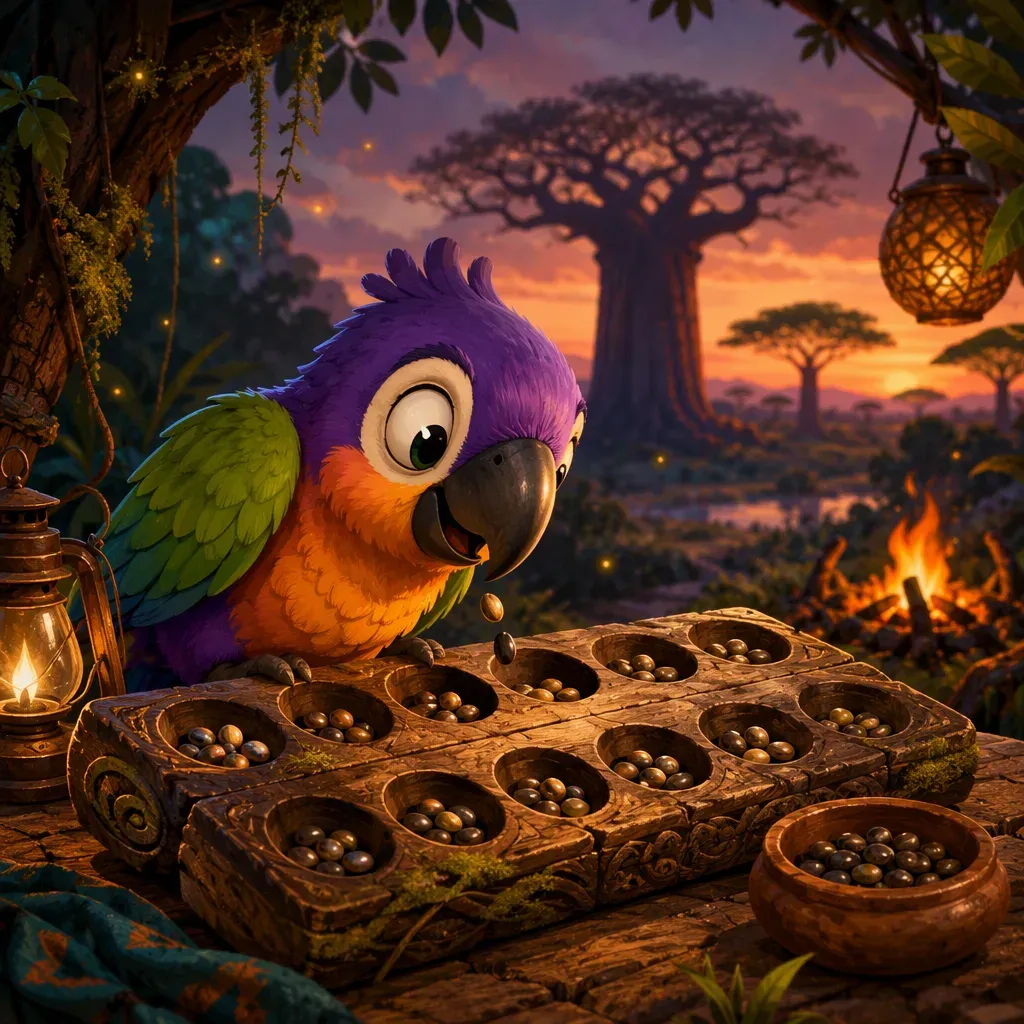
The core mechanic is beautifully tactile: players scoop up seeds, pebbles, or cowrie shells from hollows in a board and distribute them one by one around the track. Dropping the final seed into an eligible pit captures the contents. With no dice or cards involved, victory depends entirely on foresight, counting, and tempo. When a carved board is unavailable, players simply scoop shallow depressions into dirt or sand.
Hundreds of regional variations flourish worldwide: oware across West Africa, the intricate four-row bao in East Africa (Kenya, Tanzania), and toguz kumalak in Central Asia. Excellent overviews are maintained by Ancient Games and TradGames. What makes mancala captivating is how easily a simple counting exercise turns into tactical calculation - a clear reminder that enduring game designs often stem from everyday human habits.
Parrot trivia: five links between birds and brain games
Why feature parrots in a study of ancient board games? While our studio adopted the parrot as its name and symbol, the connection between these birds and puzzle-solving runs remarkably deep:
- Psittacus - a two-thousand-year-old name. Our studio name comes straight from the Latin psittacus, borrowed from ancient Greek psittakos. In the first century CE, Pliny the Elder dedicated a chapter of his Natural History to parrots, praising their ability to converse. Roman poet Martial noted a parrot that taught itself the imperial greeting Ave Caesar, a tale later recorded in medieval bestiary traditions.
- Feet built like hands. Parrots possess zygodactyl feet: two toes point forward and two point backward. This anatomical layout allows them to climb adeptly and grasp, manipulate, and rotate objects much like human hands handling game pieces. The morphology is explained in Britannica and supported by developmental biology studies on PMC.
- Avian mathematicians. Mancala rewards quick mental arithmetic. In the animal kingdom, one of the most astonishing numerical talents belonged to Alex, an African grey (Psittacus erithacus) studied by Dr. Irene Pepperberg. Alex counted sets up to six and grasped the concept of zero as an absence of quantity. His cognitive achievements were highlighted by National Geographic, the Audubon Society, and published in Animal Cognition via AAAS.
- Shared trade routes. Ancient board games and exotic birds traveled along the very same desert and maritime trade routes. Parrots entered the Mediterranean basin from India with Alexander the Great’s returning armies, arriving in Ptolemaic Egypt millennia after senet was first played, as documented in textile analyses from the Oriental Institute of Chicago.
- Sequential problem solving. Cognitive scientists regularly test cockatoos and keas with multi-stage mechanical puzzle boxes. Parrots readily learn to pull pins, turn dials, and slide bolts in a specific logical order to unlock a reward. That sequential cause-and-effect reasoning mirrors the exact thought process players use to solve deductive puzzles.
Conclusion: why simple rules stand the test of time
Senet, the Royal Game of Ur, Go, and mancala have endured because their foundations were clear: simple enough to learn in minutes, yet rich enough to reward years of practice. They avoided artificial friction and unnecessary rules, letting depth emerge naturally from the board.
That philosophy drives our work at Psittacus Studio. Great games do not need bloated menus or exhausting tutorials. They need an elegant mechanic and satisfying logic. That belief shaped Polydocu, our puzzle adventure set deep in the jungle. The surface may have changed from carved wood and dried clay to glass screens, but the joy of a well-crafted puzzle remains unchanged after five thousand years.
Frequently asked questions (FAQ)
What is the oldest board game in the world? The oldest surviving physical boards come from Egypt and are dated to around 3100 BCE, belonging to senet. The Royal Game of Ur (2600-2400 BCE) from Mesopotamia is nearly as old, but its rules are understood with far greater precision.
How do we know the rules of Senet if they were never written down? Because ancient Egyptians never recorded a rulebook, modern rules are hypothetical reconstructions. Historians like Timothy Kendall and R. C. Bell derived workable systems by analyzing the layout of the thirty squares, markings on the final fields, and tomb paintings.
How is the Royal Game of Ur different from Senet? The Royal Game of Ur is a race game across twenty squares where two players navigate separate entry tracks, fight for control of a shared central lane, and roll four-sided pyramid dice. Unlike senet, its complete rules were preserved on a Babylonian cuneiform tablet translated by Irving Finkel.
How many possible board states exist in Go? Go has an estimated 10^170 possible legal positions, far exceeding the Shannon number for chess (10^120) and the total number of atoms in the observable universe (10^80). This vast combinatorial space required modern AI systems like AlphaGo to combine deep neural networks with Monte Carlo tree search.
Is Mancala a single game? No. Mancala is a global family of hundreds of traditional sowing games. While individual variants like oware, bao, and toguz kumalak differ in pit layout and capture rules, they all share the fundamental mechanic of distributing seeds sequentially along a track.
Can parrots really understand numbers? Laboratory research with Alex the African grey parrot demonstrated that parrots can count sets up to six items, identify quantities regardless of shape or color, and understand the concept of zero as an absence of quantity.
Want to see how timeless, simple mechanics feel on your phone? Play sudoku in Polydocu, our jungle-themed adventure.
Recommended reading: the story behind our studio name, why simple game mechanics stand the test of time, our complete guide to sudoku techniques, and the history of sudoku from 1783 to the modern era.
Sources and further reading
- Metropolitan Museum of Art - Senet and Twenty Squares
- Wikipedia - Senet
- GamesFanatic - Senet, najstarsza gra planszowa? (Polish)
- British Museum - Royal Game of Ur board (1928,1009.379)
- Wikipedia - Royal Game of Ur
- RoyalUr.net - rules and the story of the Finkel ruleset
- Wikipedia - Go (game)
- Wikipedia - Shannon number
- DeepMind - AlphaGo
- Guinness World Records - first AI to beat a 9-dan professional Go player
- Ancient Games - Mancala: Africa’s Ancient Game of Sowing and Counting
- TradGames - Mancala, Oware, Bao
- National Geographic - Parrot Prodigy May Grasp the Concept of Zero
- Audubon - How Irene Pepperberg Revolutionized Our Understanding of Bird Intelligence
- AAAS - Alex the Parrot’s final experiment
- Pliny the Elder, Natural History, Book X, chapter 58 - on parrots
- Bestiary - the parrot in Isidore of Seville and Martial
- Oriental Institute Chicago - Between Heaven and Earth: Birds in Ancient Egypt (PDF)
- Britannica - zygodaktylia
- PMC - The developmental origin of zygodactyl feet
Old rules still make the best puzzles
Senet, Go and mancala lasted for millennia because their rules were short and their depth was real. Polydocu follows the same path: a sudoku board you learn in a minute, set in a jungle journey. Join the waitlist to play it on release.
One email at launch, no spam.