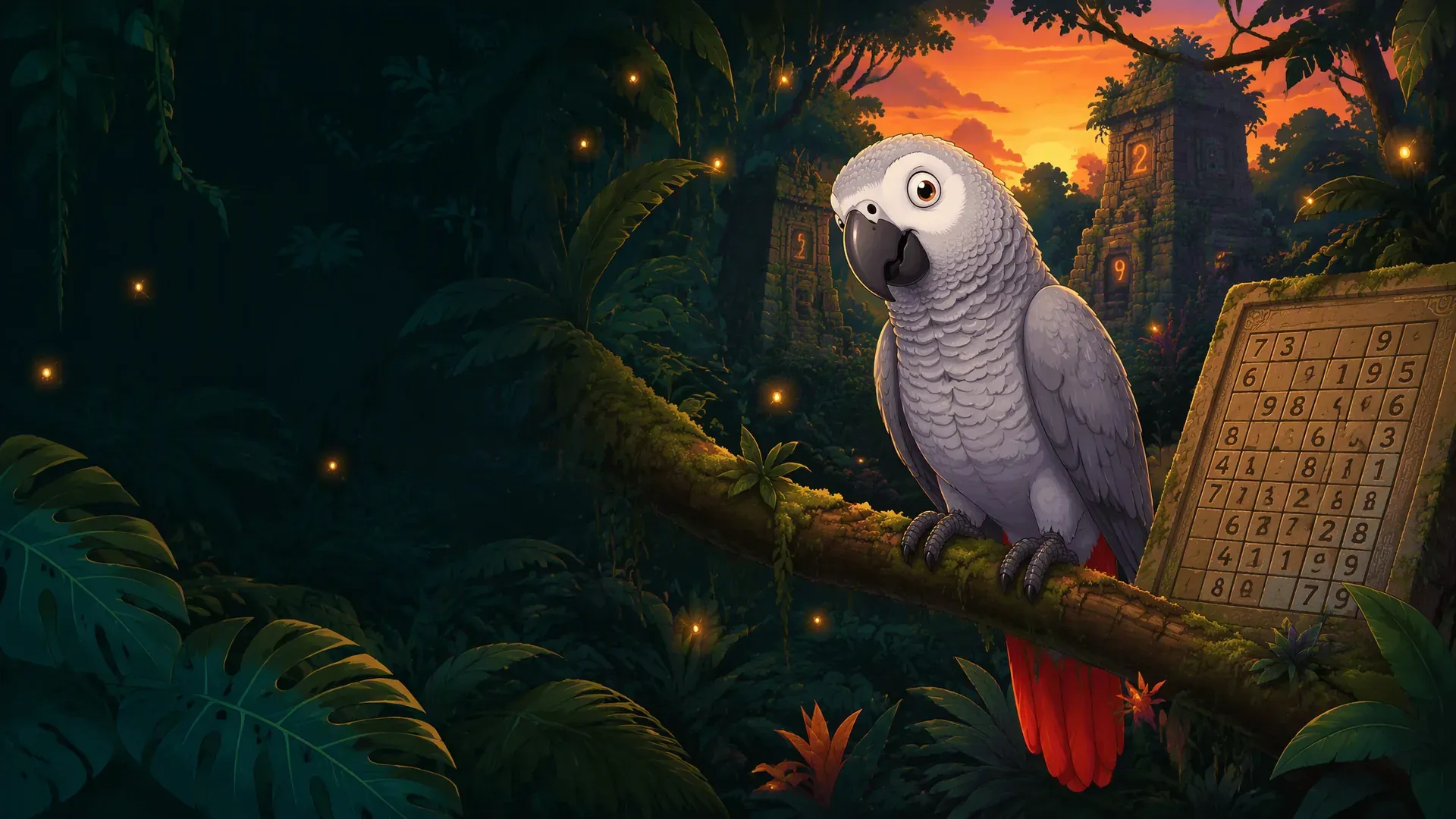
Parrots That Count Better Than You Think. The Story Behind the Name Psittacus
Where does the name Psittacus come from? Meet the African grey parrot, Alex who counted to six, and find out why the jungle never gets old in games.

Published on 10 min
On this page
Popular culture often portrays parrots simply as colorful pirate sidekicks repeating whatever words they overhear. Scientific research tells a far more compelling story. Studies in avian cognition have revealed that parrots possess sophisticated problem-solving skills, and the Latin name of one remarkable species inspired our studio. Here is the story behind the name Psittacus, what Alex the African grey proved to the world, and why jungle settings remain a timeless staple in video games.
Where does the name Psittacus come from? A short Latin lesson
Let us start with our name. Psittacus is neither a fabricated brand name nor empty pseudo-Latin. It is an established biological genus, meaning simply “parrot” in Latin. The origin traces back to ancient Greece: the Greek word psittakos (ψιττακος) described birds that could imitate human speech, and the word itself was likely onomatopoeic, mimicking parrot vocalizations.
Carl Linnaeus formally established the genus Psittacus in 1758 in the tenth edition of Systema Naturae, which laid the foundations of modern taxonomy. Originally, Linnaeus grouped all 37 parrot species known at the time into that single genus. Today, only two species remain in Psittacus: the African grey parrot (Psittacus erithacus), designated as the type species, and the smaller Timneh parrot. The species behind our studio’s name inhabits the rainforests of West and Central Africa, from Côte d’Ivoire to western Kenya. The grey parrot is classified as Endangered on the IUCN Red List, and international trade in the species is strictly regulated under CITES.
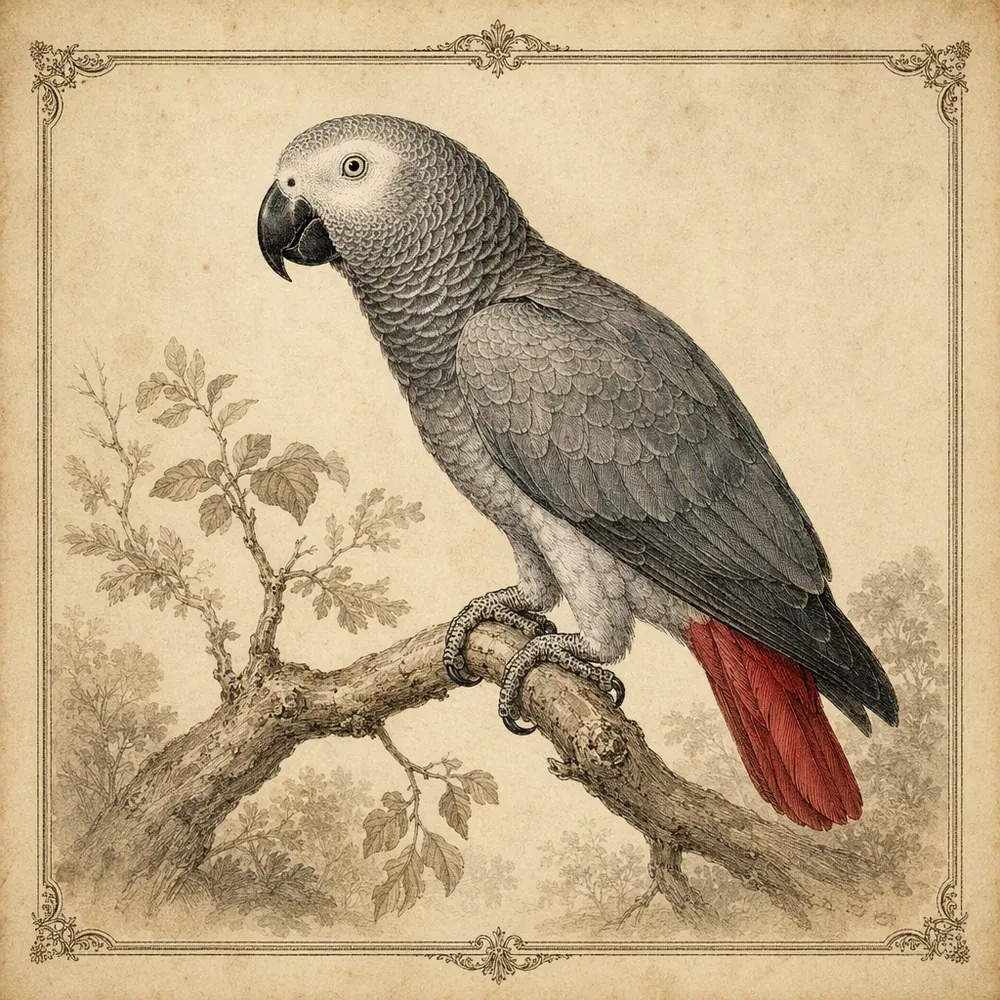
The African grey parrot: a genius in grey feathers
Look at photos of a grey parrot. Grey body, red tail, black beak. Understated, as parrots go. Yet National Geographic calls it the greatest mimic of human speech among roughly 350 parrot species and reports cognitive skills comparable to those of a five-year-old child. Among birds, that is absolute elite.
What earns the grey parrot that place:
- Grey parrots cooperate with flock mates they have never met and help them without expecting anything in return. Researchers call this prosocial behavior, and it was once considered the private property of primates.
- In the wild they live in flocks, fly many miles a day in search of food, and routinely reach 60, sometimes 80 years of age. Buying a parrot means committing to a companion for life, often longer than your own.
- Parrots do not vocalize with vocal cords. Their sound organ is the syrinx, located at the base of the trachea. The syrinx is what lets a parrot copy doorbells, microwaves, and crying babies with eerie accuracy. On top of that, parrot brains have a song system with an unusual core-plus-shell structure, which makes them true vocal learners rather than loud repeaters.
- Parrots handle tools surprisingly well. A kea named Bruce, who is missing his upper beak, holds a pebble in his beak to preen his feathers, and when he drops it he retrieves the same pebble or a very similar one. Researchers logged more than 20 hours of observation to confirm this was no accident.
People have been fascinated by talking parrots forever. The first written account of a speech-imitating bird comes from the Greek historian Ctesias of Cnidus, who described a bird called bittakos in the fifth century BC. Sound familiar? The Greeks had parrots on record long before most languages had a word for them.
Can parrots count? The story of Alex
Here is where the story gets serious. In 1977, freshly minted PhD Irene Pepperberg bought a one-year-old grey parrot at a pet shop. She named him Alex, short for “avian language experiment”. An ordinary purchase with extraordinary consequences: the Pepperberg and Alex experiment ran for thirty years and turned the science of bird cognition upside down.
Until then, the accepted view was that complex language behavior required a large mammalian brain. Pepperberg proved otherwise. Her method relied on the so-called model/rival technique: the parrot watched two trainers talk about objects instead of being rewarded for repetition. The results exceeded every expectation:
- Alex learned about 150 English words and used them deliberately, not at random. He could say “want grape” or “wanna go back”, and he protested when things did not go his way.
- He identified 50 objects, 7 colors, and 5 shapes, and understood the concepts of “bigger”, “smaller”, “same”, and “different”.
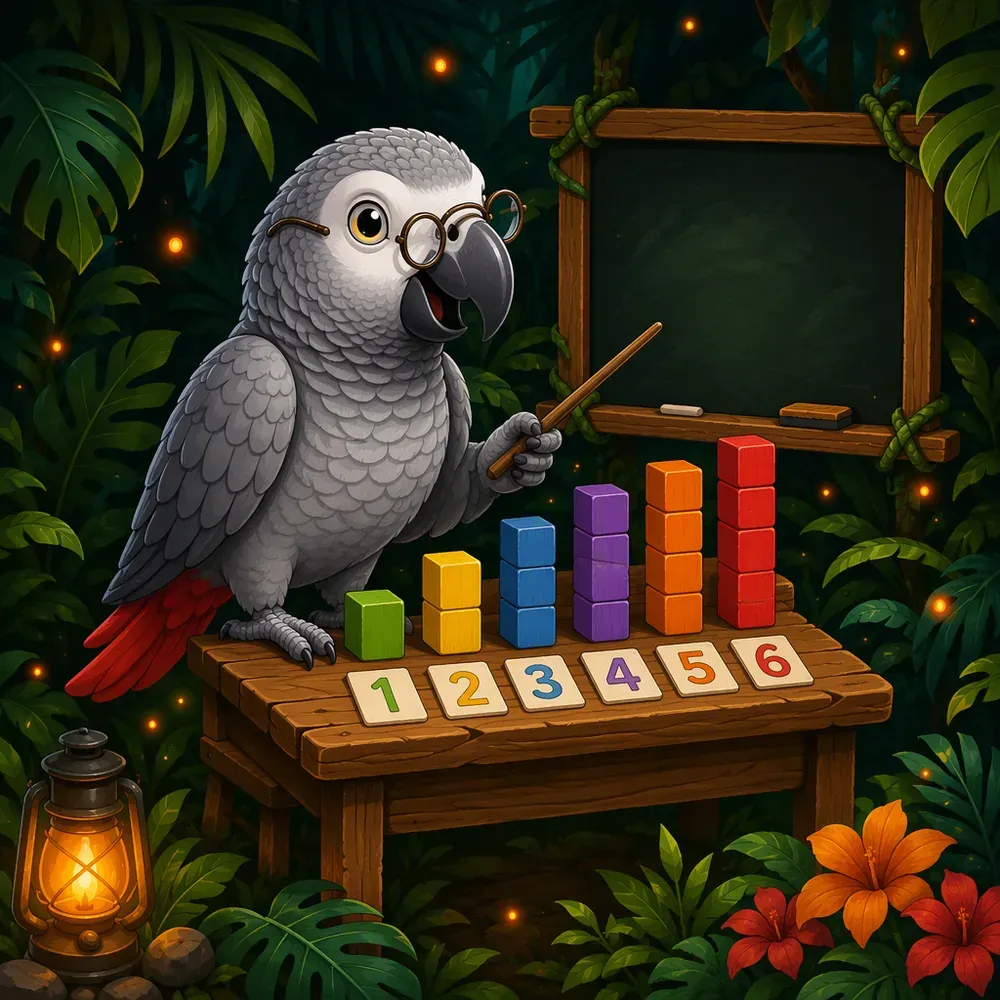
- He counted to six. In his final experiment, cut short by his death, Alex added Arabic numerals shown on cards (9 correct answers out of 12 trials) and summed three sets of objects hidden under cups one after another (8 out of 10). Those skills put him on par with chimpanzees.
- He grasped “none”, a zero-like concept. Zero is an abstraction that human children typically master around age four.
- When Pepperberg snapped her fingers, waiting for another lab parrot to answer, and the bird stayed silent, Alex volunteered the answers himself: “four”, then “six”. It is one of the most famous anecdotes in animal cognition and a strong hint that he was genuinely counting rather than guessing.
| Task | Alex’s result |
|---|---|
| Add Arabic numerals shown on cards | 9 correct out of 12 trials |
| Sum three sets of objects hidden under cups | 8 correct out of 10 |
| Count aloud | up to six |
| Grasp a zero-like concept (“none”) | understood |
Alex died suddenly on September 6, 2007, at the age of 31. On his last evening, Pepperberg told him: “You be good, see you tomorrow. I love you.” Alex replied: “You’ll be in tomorrow.” The next morning, the bird who changed the science of minds did not wake up. Pepperberg’s papers appeared in the Journal of Comparative Psychology and Animal Cognition, and the Alex Foundation continues parrot cognition research to this day.
Parrots in games: not always the sidekick
Given how clever parrots are, it is no surprise that game developers and filmmakers keep giving them bigger roles than set decoration. The most famous example is probably Iago from Disney’s 1992 Aladdin, the red parrot and raspy right hand of Jafar, voiced in the original by Gilbert Gottfried. Iago is petty, greedy, and brutally funny, which is to say exactly like a real parrot after a few years in a family home. Fun fact: the character’s name nods to Shakespeare, since Iago is the villain of Othello, and the parrot later flew into the Kingdom Hearts series.
Some game mechanics grew straight out of bird lore. The Chocobo from Final Fantasy is one of the most recognizable mounts in gaming history, present in the series since 1988 and starring in its own spin-offs, from racing to dungeon crawlers. And the pirate canon, a captain with a parrot on the shoulder, works in seafaring games almost as reliably as a hook for a hand. In pop culture a parrot is always a character who knows more than it says, and it says a lot. It is the same pull that kept Snake on hundreds of millions of phones, a story we tell in full here.
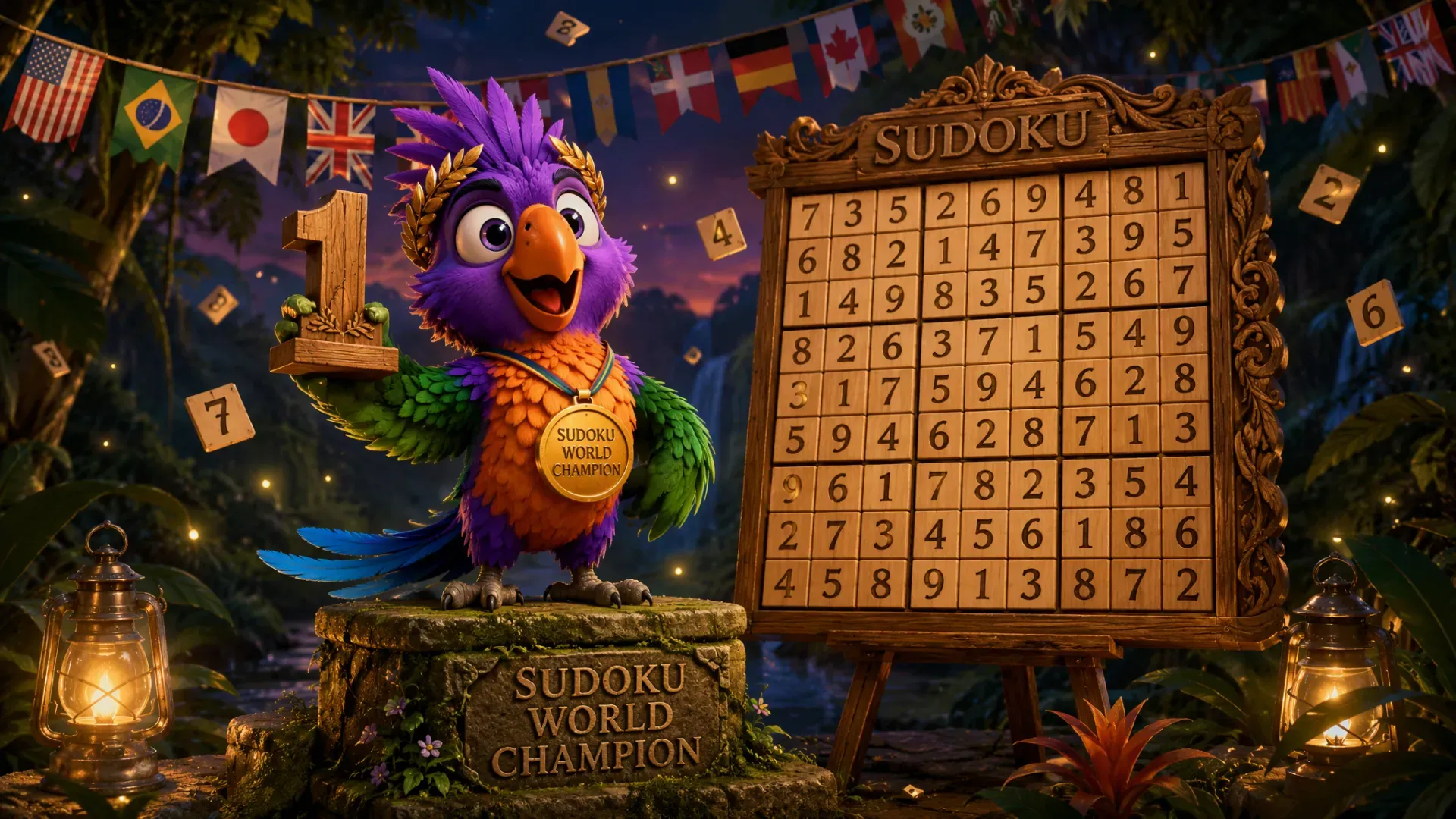
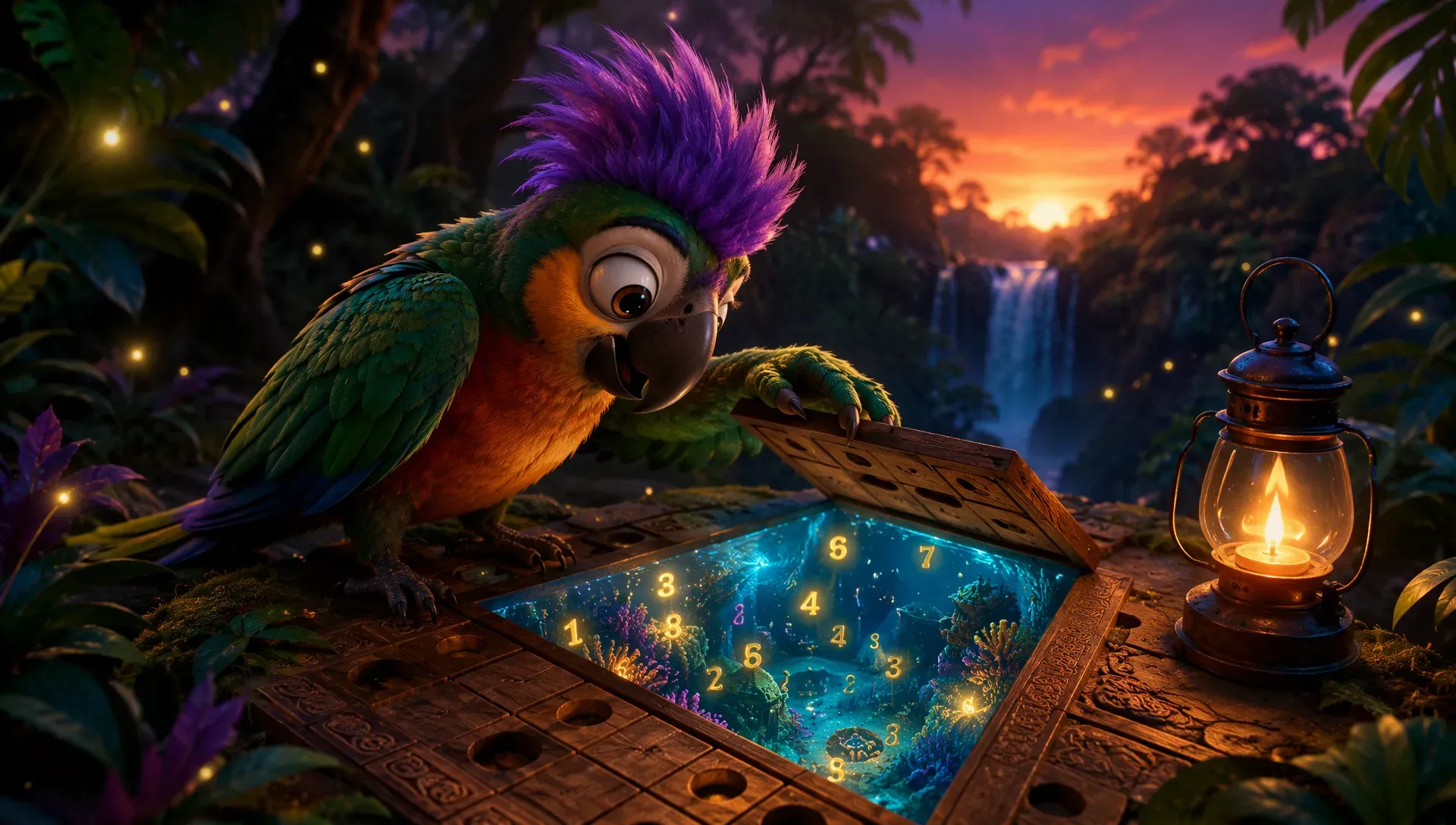
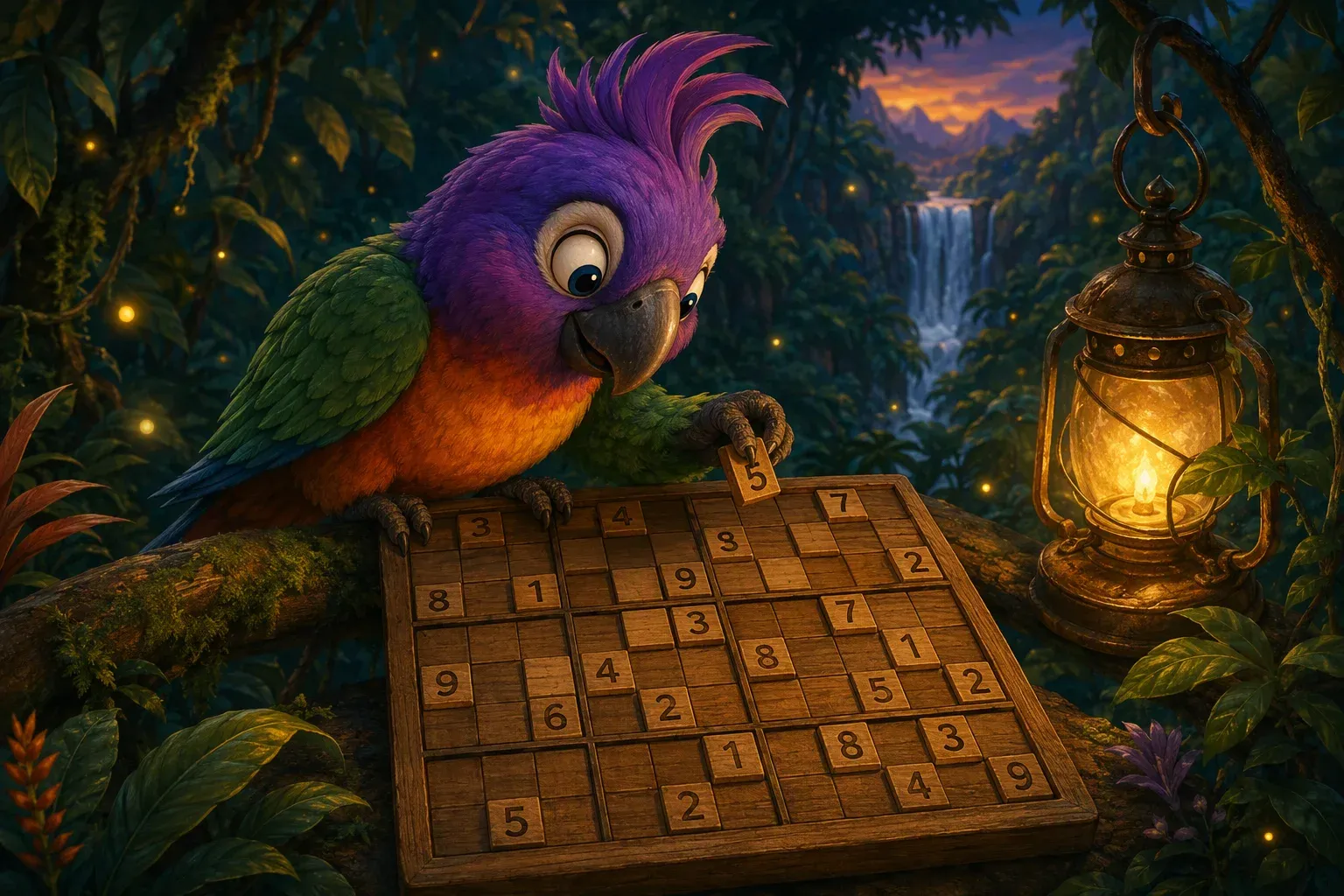
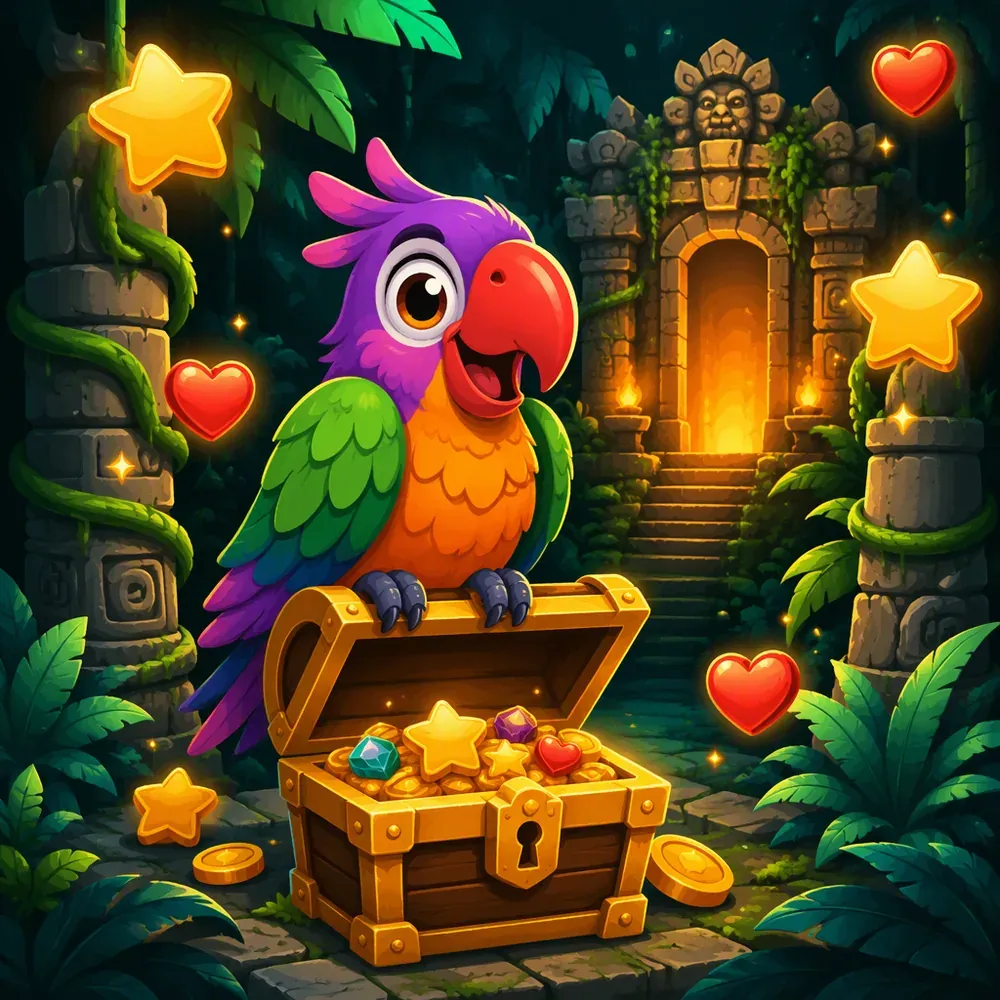
Which brings us back home. In Polydocu, our first game, the role of the clever companion belongs to Poly, a parrot who keeps score and comments on your progress across the map. Which makes sense: in a studio named after the smartest parrots on the planet, the bird had to be bright and had to have an opinion about everything.
The jungle in video games: the green gold standard
The second pillar of Polydocu is, of course, the jungle. The tropical forest motif has a long and honorable career in games, reaching back to the Atari era. Here is why developers love it and why players never tire of it:
- The jungle draws natural level boundaries. Thick vegetation hides the horizon, so the world feels huge even when the map is compact. Production value and sense of scale in one move.
- Green sets the mood. Unlike deserts or snowy wastes, a jungle pulses with life: vines to grab, canopy layers, hidden paths. It pairs perfectly with drum-based music and with sounds you cannot quite place as animals or enemies.
- It is a stealth playground. Far Cry from 2004 and later Crysis showed that leaves and tall grass are the best camouflage nature ever invented, while incidentally melting GPUs better than any benchmark.
- The jungle promises treasure and mystery. From Pitfall! in 1982 to Tomb Raider with its Lost Valley full of dinosaurs, and the first Uncharted, where Nathan Drake hunts for the legendary El Dorado in the Amazon, a tropical forest implies a ruin behind every corner.
The list of iconic video game jungles is long: the opening Jungle Hijinx stage of 1994’s Donkey Kong Country, the island levels of Crash Bandicoot, the Faron region in Zelda: Breath of the Wild. Say “jungle level” to a gamer and they will immediately picture green, vines, and something waiting to be discovered.
Frequently asked questions
Where does the name Psittacus come from?
It is the Latin word for parrot, and a real genus that Carl Linnaeus established in 1758. Our studio is named after the grey parrot, Psittacus erithacus, the type species of that genus.
Can parrots really count?
The grey parrot Alex counted to six, added Arabic numerals shown on cards and summed hidden sets of objects, and understood a zero-like concept. In his final experiment he matched chimpanzees on those tasks.
How long do African grey parrots live?
In the wild they routinely reach 60 and sometimes 80 years, which is why buying one means committing to a companion for life.
Is the grey parrot endangered?
Yes. It is listed as Endangered on the IUCN Red List, and international trade in the species is restricted under CITES.
Parrots, jungles, and sudoku
Why do these themes matter to us? Because Polydocu brings these worlds together. For us, a sudoku grid becomes a clearing in the rainforest: solve the board, earn stars, and open the next stretch of the saga map, with Poly accompanying you along the way. The rules remain entirely classic - free from rushing countdown timers and artificial paywalls. Layered on top are daily quests, collections, and global leaderboards. Our Poznan studio believes that simple, elegant ideas paired with an engaging companion make for a memorable adventure.
Ready to explore the jungle with Poly? Join the waitlist for Polydocu and we will let you know when the game launches on iOS and Android. Discover more about the game on our Polydocu page.
Sources
- Psittacus (genus) (Wikipedia)
- Grey parrot (Wikipedia)
- African gray parrots, facts and photos (National Geographic)
- Recent developments in parrot cognition (PMC)
- Syrinx (bird anatomy) (Wikipedia)
- Why Parrots Talk (Parrot Society Singapore)
- Alex (parrot) (Wikipedia)
- Numerical competence in an African gray parrot (Journal of Comparative Psychology, 1994)
- Number comprehension by a grey parrot, including a zero-like concept (Journal of Comparative Psychology, 2005)
- Grey parrot numerical competence: a review (Animal Cognition, 2006)
- Cognitive and communicative abilities of Grey parrots (Applied Animal Behaviour Science, 2006)
- Alex the Parrot’s final experiment (AAAS)
- The Alex Foundation
- Iago (Aladdin) (Wikipedia)
- The Top 10 Birds/Avians in Video Gaming (GameFAQs)
- Top 10 Video Game Forest and Jungle Levels (WatchMojo)
- Top 10: Jungle levels in games (GamingBoulevard)
- 10 Video Games That Had Great Jungle and Forest Settings (GamingBolt)
Meet Poly and explore the jungle trail
Poly the parrot is your lively companion in Polydocu: celebrating clean moves, tracking stars, and guiding you across the saga map. Join the waitlist to try the game on release.
One email at launch, no spam.