How to Play Sudoku: A Complete Guide to Rules and Solving Techniques
Learn sudoku from scratch: the rules, naked single, hidden single, pairs and triples, X-Wing, difficulty levels, and the most common beginner mistakes.

Published on 11 min
On this page
In sudoku, digits carry no arithmetic value. They serve as symbols for nine distinct elements that you must logically arrange on a grid. You could play the exact same puzzle using letters, colors, or geometric shapes. Every move is an exercise in pure deduction: if a row already holds an 8, no other cell in that row can be an 8. In this guide, you will find everything you need to start solving with confidence: the rules explained from scratch, the core solving techniques, and an answer to whether every valid sudoku puzzle has only one unique solution.
Sudoku rules in two minutes
The board consists of a 9x9 grid divided into nine 3x3 boxes. Some cells are pre-filled as starting clues (known as givens). Your objective is to fill the remaining cells with digits from 1 to 9.
The rules are straightforward and can be summed up in three points:
- every row must contain digits 1 through 9, exactly once,
- every column must contain digits 1 through 9, exactly once,
- every 3x3 box must contain digits 1 through 9, exactly once.
In practice, solving comes down to systematic elimination. You inspect the grid cell by cell, looking at how rows, columns, and boxes intersect.
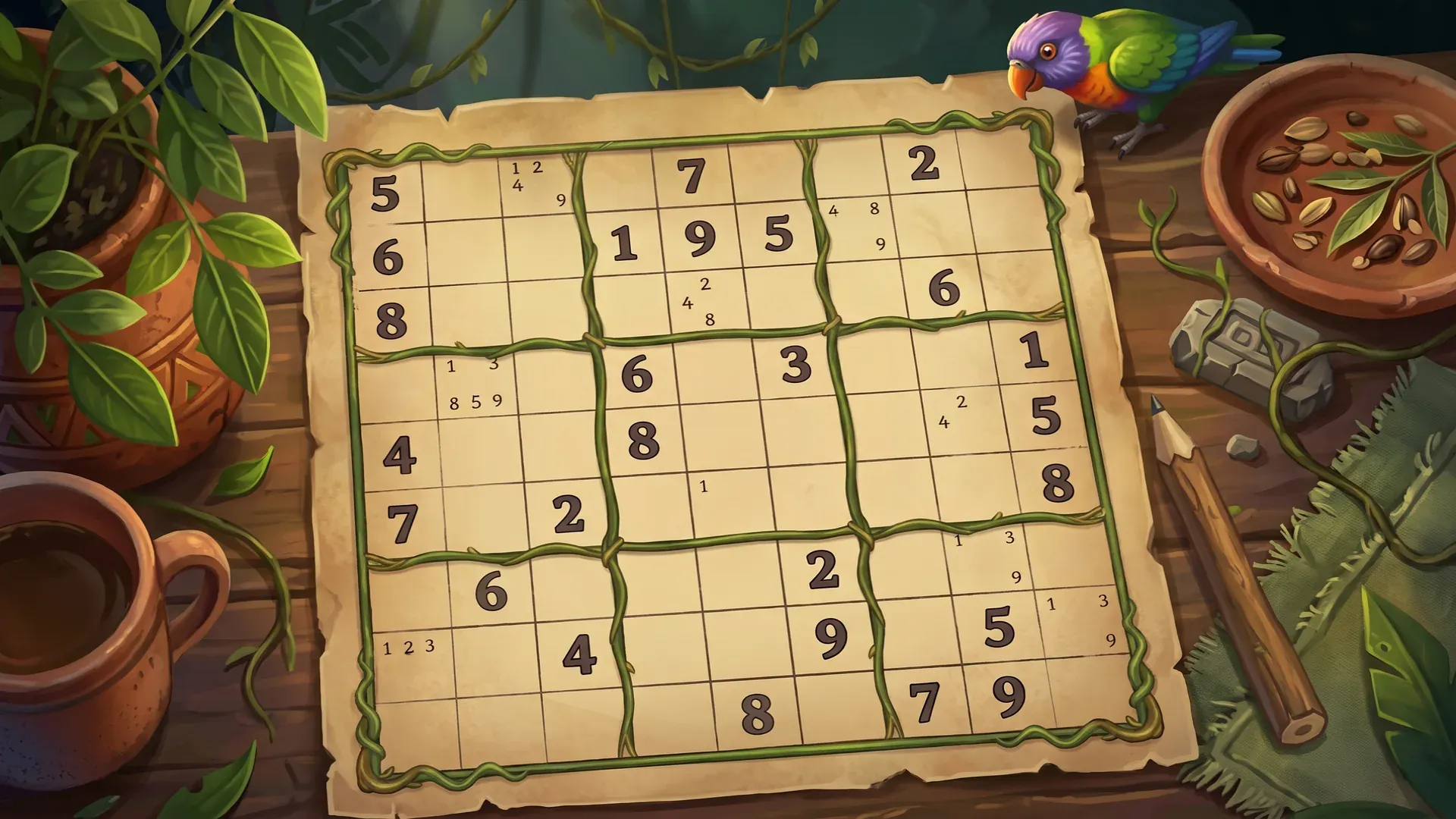
Two concepts are helpful to know before you begin. Candidates are the possible numbers that could fit into a given cell, not yet ruled out by what exists in its row, column, or box. Pencil marks are small notes written in the corners of cells to track those possibilities. Conceptis Puzzles accurately describes pencil marking as a “systematic process” - notation is not a cheat sheet, but a way to make the logic of the puzzle visible.
First steps: scanning and pencil marks
The simplest way to start is to scan rows and columns (often called cross-hatching). Pick one digit, say 5, and trace every 5 on the board. Each one blocks its own row, column, and box, so once a box has only one free cell left, you know that cell belongs to the digit you’re following.
Here are two tips that save a lot of time in your first games:
- Start with the most frequent digits. If seven 6s are already placed, finding the last two comes easier than hunting down a lone 1, because every 6 already on the board takes cells away from the remaining boxes.
- Write in your candidates, but not right away. On easy puzzles, notation only slows you down, so bring it in once plain scanning stops producing moves. That is the point where the easy level ends and medium begins.
Naked single and hidden single: the fundamentals
These two techniques are the foundation everything else stands on, because they solve most easy puzzles and a good share of medium ones.
Naked single
The cell has only one candidate, so since nothing else can go there, you write that digit in immediately.
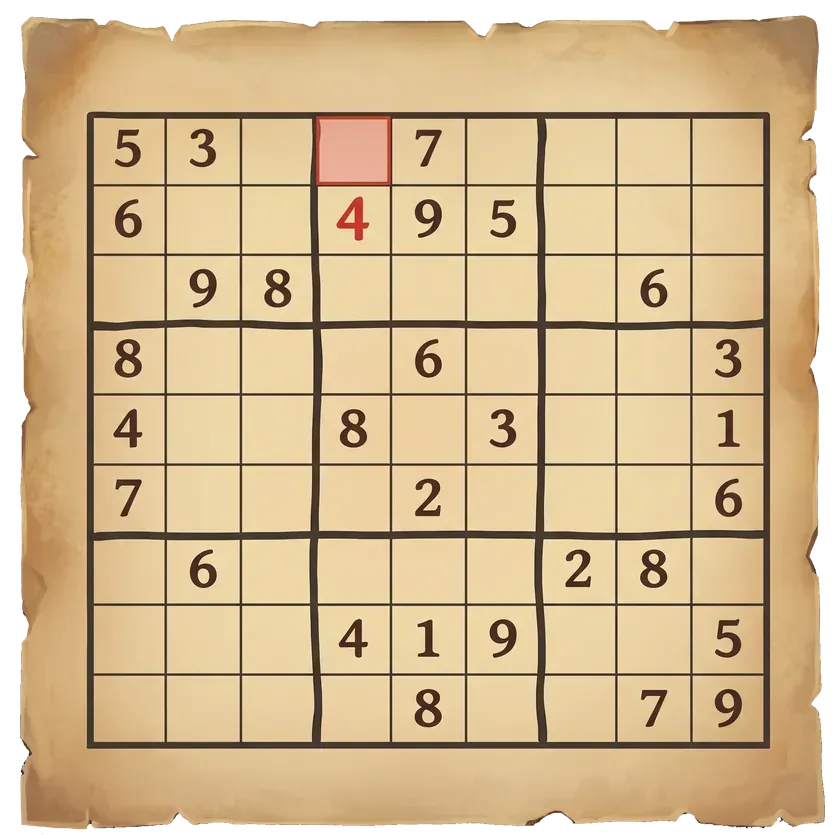
It sounds trivial, but in practice it takes discipline. Until your candidates are written down or held in memory, it’s easy to miss a cell where nine options shrank to one. The HoDoKu solver is one of the most thorough collections of solving techniques ever put together, and its authors point out something interesting: on paper, hidden singles are easier to spot, while in software with automatic notation it’s the other way round. So it’s worth training both, because each one forces you to do work the other does for you.
Hidden single
Here the situation is a little sneakier, because the cell holds many candidates. Even so, within its row, column, or box it is the only place left for a given digit. Suppose the middle box is missing a 4, and every free cell except one is blocked by 4s from neighboring rows and columns. One cell survives, and that cell is the hidden single. The digit is “hidden” because it gets lost among the other pencil marks.
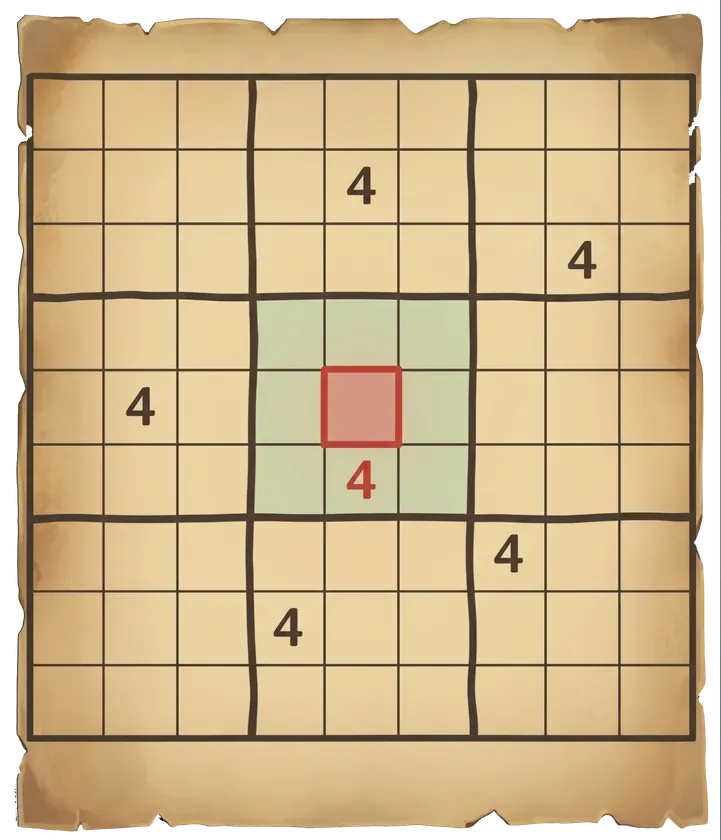
How do you find one without full notation? By the method HoDoKu calls cross-hatching. Focus on one digit and one box, then imagine striking out every row and column that already contains that digit. Exactly one cell survives, and that is your move.
Both techniques solve most sudoku labeled easy and medium, so if you get stuck on a medium puzzle, the odds are you’ve simply missed one of them. Go back to scanning before you reach for advanced techniques.
Pairs and triples: naked and hidden
Once singles stop being enough, subsets come into play, starting with pairs and moving on to triples.
Naked pair
In one row, column, or box there are two cells holding exactly the same pair of candidates, and nothing else. Say two cells each show {1, 5}. We don’t know which one gets the 1 and which gets the 5, but we do know that the 1 and the 5 fit only in those two cells. Every other cell in that unit therefore loses both candidates.
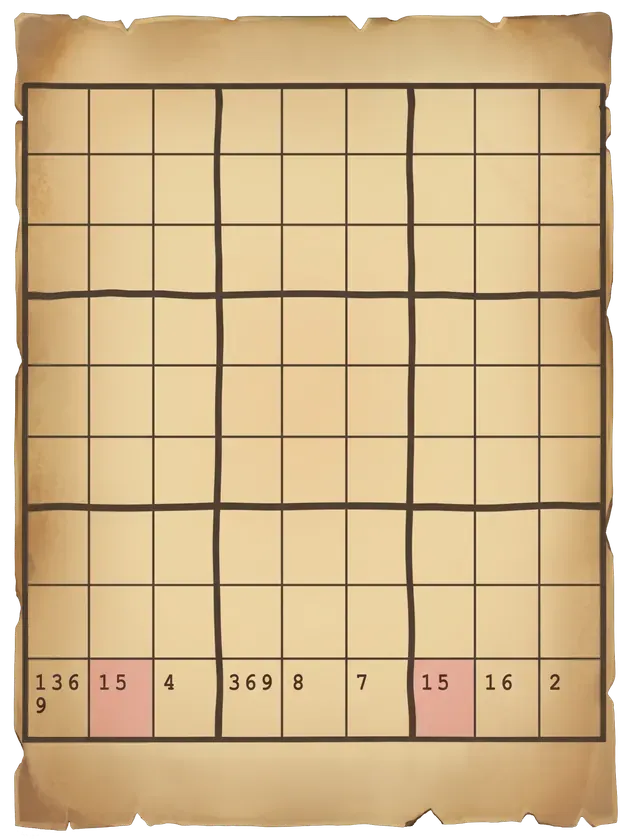
A single elimination like that often reveals the next single, so moves start coming one after another, like dominoes.
Naked triple
The same principle works at three-cell scale. If three cells in one unit together hold exactly three candidates (e.g. {1,5}, {1,5,9}, {5,9}), those three candidates fit only in those three cells. You therefore remove them from the rest of the unit. Triples are harder to spot because the candidates don’t have to be spread evenly.
Hidden pair and hidden triple
This time you look not at cells but at digits. If within a unit a given pair of digits can appear in only two cells, the pair is locked there, no matter that those cells hold other candidates too. You erase every other digit from them, and a naked single often appears straight away. Poziomo-Pionowo walks through exactly this technique step by step, alongside its Polish terminology for pointing, hidden, and naked pairs and triples.
The idea is simple, but a hidden pair can be fiendishly invisible, because extra candidates camouflage the pattern. It’s worth hunting methodically, checking for each digit how many cells of the unit can still hold it.
X-Wing: the first truly advanced technique
X-Wing is the moment many players stick with sudoku for good, because the board suddenly turns out to hide geometric patterns you can use.
The rule: pick a digit, say 6. Suppose that in two different rows the 6 can appear in only two columns, and that in both rows these are the same two columns. Those four cells then form a rectangle, and the 6 will land on one of the rectangle’s two diagonals. We don’t know which, but either way both columns get their 6, so you can eliminate 6 from those two columns everywhere outside the rectangle.
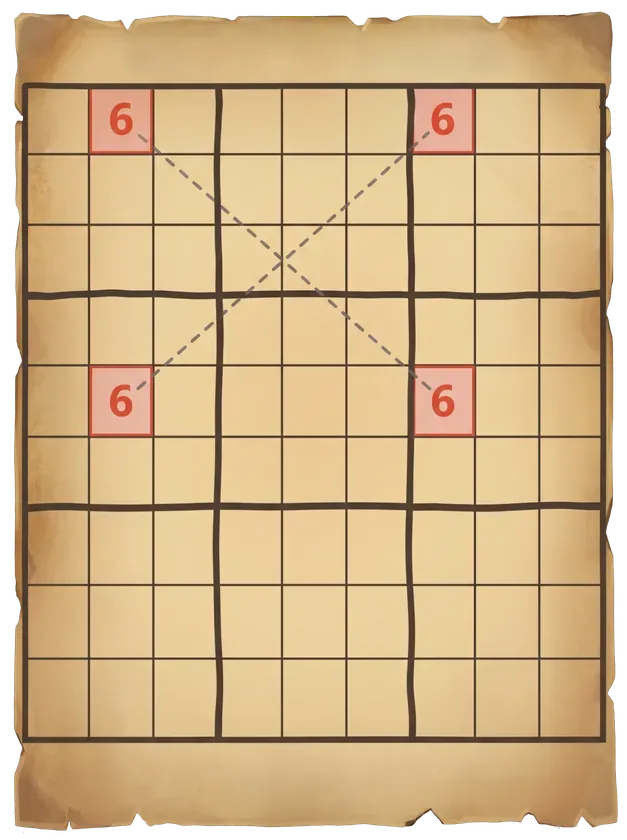
Why does this work no matter which diagonal you pick? Because each row must contain the 6 exactly once, and it can only do so in one of the rectangle’s two columns. Both rows therefore spend their 6s exclusively in those columns, which means no other cell in those columns has the right to hold one. Wikipedia’s “Mathematics of sudoku” presents X-Wing as a pattern-recognition technique. That’s the right framing, because X-Wing isn’t about guessing: you recognize a shape and draw the conclusion.
The natural successor to X-Wing is the Swordfish, which is the same logic stretched across three rows and three columns. It shows up rarely and is hard to spot, but it can crack open an expert puzzle that looked hopeless.
Difficulty levels: what actually makes a puzzle hard
Anyone who has moved from “easy” to “medium” knows the feeling: the game suddenly starts fighting back. But what makes a sudoku hard isn’t the number of givens, it’s the techniques the puzzle requires, because two puzzles with an identical number of filled cells can demand completely different work.
- Easy puzzles keep every move on the surface, so scanning, naked and hidden singles are enough.
- Medium puzzles call for pairs and triples (naked and hidden) plus pointing pairs, and without pencil marks things get tough.
- Hard puzzles bring in hidden subsets, pointing triples, and sometimes a basic X-Wing, so the board demands patient candidate analysis.
- Expert puzzles reach for X-Wing, Swordfish, Y-Wing, and even more exotic techniques. Here solving ends and pattern-hunting begins.
That’s why one puzzle yields to singles alone while another demands a Swordfish, even though the two hold the same number of givens. Puzzle generators rate difficulty by which techniques a solver has to use, not by how many cells are empty.
Does sudoku always have one solution?
Short answer: no, but a proper puzzle does. A sudoku with exactly one solution is called a proper puzzle in the literature. Multiple solutions usually signal an error, and the culprit could be a bad app, a grid mis-transcribed from a newspaper, or your own digits entered too hastily.
There’s another fact here that tends to impress people. The minimum number of givens that guarantees a unique solution is 17. For years this was only a conjecture, because plenty of 17-clue puzzles were known and not a single 16-clue one had been found, yet nobody could prove it. Then in 2012 Gary McGuire and his team at University College Dublin proved it by exhaustive search, burning through 7.1 million core-hours of computation. As Wikipedia notes, there are 6,670,903,752,021,072,936,960 possible completed sudoku grids, and not one of them can be pinned down by 16 clues.
There’s also a condition you can check yourself. A proper puzzle must contain at least eight different digits, because if one digit (or two) never appeared among the givens, you could swap them throughout any solution and get a second, equally valid one.
From all of this one practical conclusion follows. If you solve sudoku in a good app, you can trust the puzzle has one solution, and every logical, elimination-based move you make is safe. Guessing in sudoku always means a move was missed, not that the puzzle was unusually hard.
The most common beginner mistakes
After digging through hundreds of boards, you notice that beginners stumble over the same handful of things every time. Here are the classics:
- Guessing instead of eliminating. In a proper sudoku there’s nothing to guess, so if you’re “trying” a digit, you usually missed a single or a pair. Go back to scanning.
- Forgetting the 3×3 boxes. Beginners track rows and columns but treat the box as an afterthought, even though it’s a separate unit where plenty of hidden singles are hiding.
- No notation, or messy notation. Without candidates written down, pairs are invisible, and with stale candidates you mislead yourself. Golden rule: every time you place a digit, immediately erase it from the pencil marks in its row, column, and box.
- Stale pencil marks after a wrong move. One incorrect digit cascades through the whole board, so if things stop adding up, check your last move instead of blaming the hard puzzle.
- Using a pen. Sounds like a joke, but it’s serious, because sudoku trains working memory and an eraser encourages you to verify your moves. On paper, use a pencil.
Frequently asked questions (FAQ)
Is sudoku good for your brain? Sudoku trains working memory and logical elimination, so you practice holding several constraints in your head at once. It’s good mental exercise, though it won’t replace a walk or a good night’s sleep.
Where should a beginner start? With easy puzzles and the naked single and hidden single techniques. Once plain scanning stops being enough, add pencil marks and learn pairs, because every other technique is just an extension of those two ideas.
What’s the difference between a naked pair and a hidden pair? In a naked pair, two cells hold only the same pair of candidates, so you look at cells. In a hidden pair, two digits can appear in only two cells, so you look at digits. The elimination is similar, but the mechanics differ.
What should I do when I’m stuck on a hard puzzle? First, go back to singles and check every digit in every box. Then verify your pencil marks are up to date, next look for pairs and triples, and only after that reach for X-Wing. Getting stuck almost always means a basic move was overlooked.
Can a sudoku have more than one solution? Yes, because a grid with few givens may fail the uniqueness condition. That’s exactly why apps and publishers verify puzzles before publishing them.
Ready to test these techniques? Play sudoku in Polydocu, our jungle-themed sudoku adventure, featuring handy note-taking and levels from beginner to expert.
Recommended reading: the story behind our studio name, how we design accessible boards for every player, 7 rules for mobile game UX design, 8 fascinating sudoku variants, the history of sudoku, and why simple game mechanics stand the test of time. If you want to train your working memory, explore our guide to the memory palace and mnemonic techniques.
Ready to test these techniques on a real board?
Polydocu blends classic sudoku with a refreshing jungle journey. Use clear pencil marks, explore the saga map, and enjoy puzzle solving at your own pace. Join the waitlist to play at launch.
One email at launch, no spam.