Sudoku Variants: 8 Types of Sudoku and How Each One Changes the Game
A field guide to 8 sudoku variants: even-odd, greater-than, killer, thermo, jigsaw, twodoku and flower sudoku. Discover rules, tactics and difficulty levels.

Published on 13 min
On this page
When sudoku swept across newspapers worldwide in 2004 and 2005, puzzle editors quickly looked for fresh twists on the formula. Within months, publications like The Times introduced killer sudoku, samurai sudoku, and supersized 16x16 grids alongside the classic 9x9 layout. Today, the family of sudoku variants includes dozens of formats, and modern puzzle apps frequently offer more variations than the original game.
The great appeal of these variants is that you do not have to learn a completely new game from scratch. Every variant keeps the familiar core rules (every row, column, and block must contain each digit without duplicates) and adds a single new rule or board modification. Because of this, you can pick up the mechanics in minutes, while the new logical constraints completely refresh how you play.
This guide walks through eight types of sudoku featured in our upcoming game Polydocu. Below, you will find authentic boards from the game, the core solving tactics behind each variant, and an honest assessment of their difficulty.
The sudoku variant family at a glance
| Variant | What changes | Signature tactic | Typical difficulty |
|---|---|---|---|
| Classic | Standard baseline | Singles, pairs, triples, X-Wing | Easy to expert |
| Even-odd | Certain cells require even or odd digits | Parity counting and elimination | Easy to medium |
| Greater-than | Inequality signs between neighboring cells | Inequality chains and range narrowing | Medium to hard |
| Killer | Cages with target sum values | The 45 rule and unique sum sets | Medium to expert |
| Thermo | Strictly increasing digit lines | Endpoint bounds and extremes | Medium to hard |
| Jigsaw | Irregular, interlocking box shapes | Law of Leftovers | Medium to hard |
| Twodoku | Two overlapping 9x9 grids | Cross-grid clue propagation | Medium to hard |
| Flower | Five deeply overlapping grids | Inward solving toward the center grid | Hard |
Classic sudoku: the baseline everything borrows from
The classic puzzle consists of a 9x9 grid divided into nine 3x3 square blocks. Your goal is to fill the empty cells with digits from 1 to 9 so that every row, column, and block contains each digit exactly once. It requires no arithmetic or guessing: the solution unfolds entirely through deduction and elimination.
The modern format was created in 1979 by American architect Howard Garns. Japanese publisher Nikoli refined the design and gave it the name Sudoku in the 1980s, and Wayne Gould helped launch the global craze in the early 2000s by developing automated puzzle software for major newspapers. We explore that journey in our history of sudoku, and we explain fundamental deduction methods in our complete guide on how to play sudoku.
This standard 9x9 layout serves as the benchmark for every variant described below.
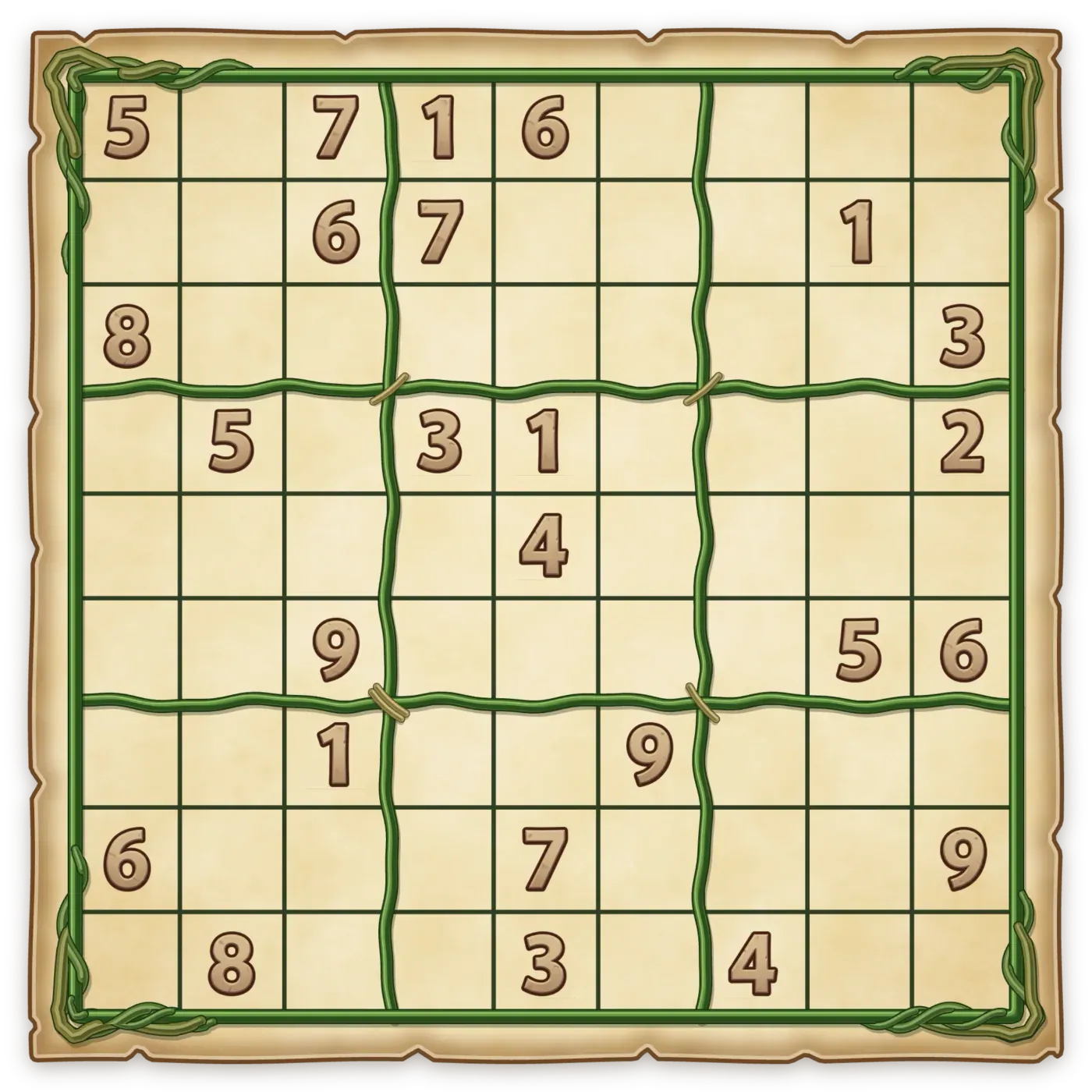
Classic sudoku in Polydocu. The 9x9 board is the reference point for all other variants.
1. Even-odd sudoku: parity becomes a clue
In even-odd sudoku, specific cells on the board are marked with symbols that dictate whether the digit inside must be even or odd. In Polydocu, we use a clean and intuitive convention: circles require even digits (2, 4, 6, 8), and diamonds require odd digits (1, 3, 5, 7, 9). Some print publications use shaded squares or alternate markings, so it is always wise to check the legend before starting.
The foundational tactic here is parity counting. In a standard 9x9 board, each row, column, and block contains exactly four even digits and five odd digits (on a compact 6x6 board, the split is three and three). By counting the marked cells in any line, you immediately deduce how many unmarked cells must hold remaining evens or odds. Furthermore, knowing a cell’s parity instantly cuts candidate possibilities in half, making it much easier to spot naked singles early in the game.
Difficulty leans toward the gentler side. Even-odd sudoku is the most welcoming variant for newcomers looking to branch out from the traditional rules.
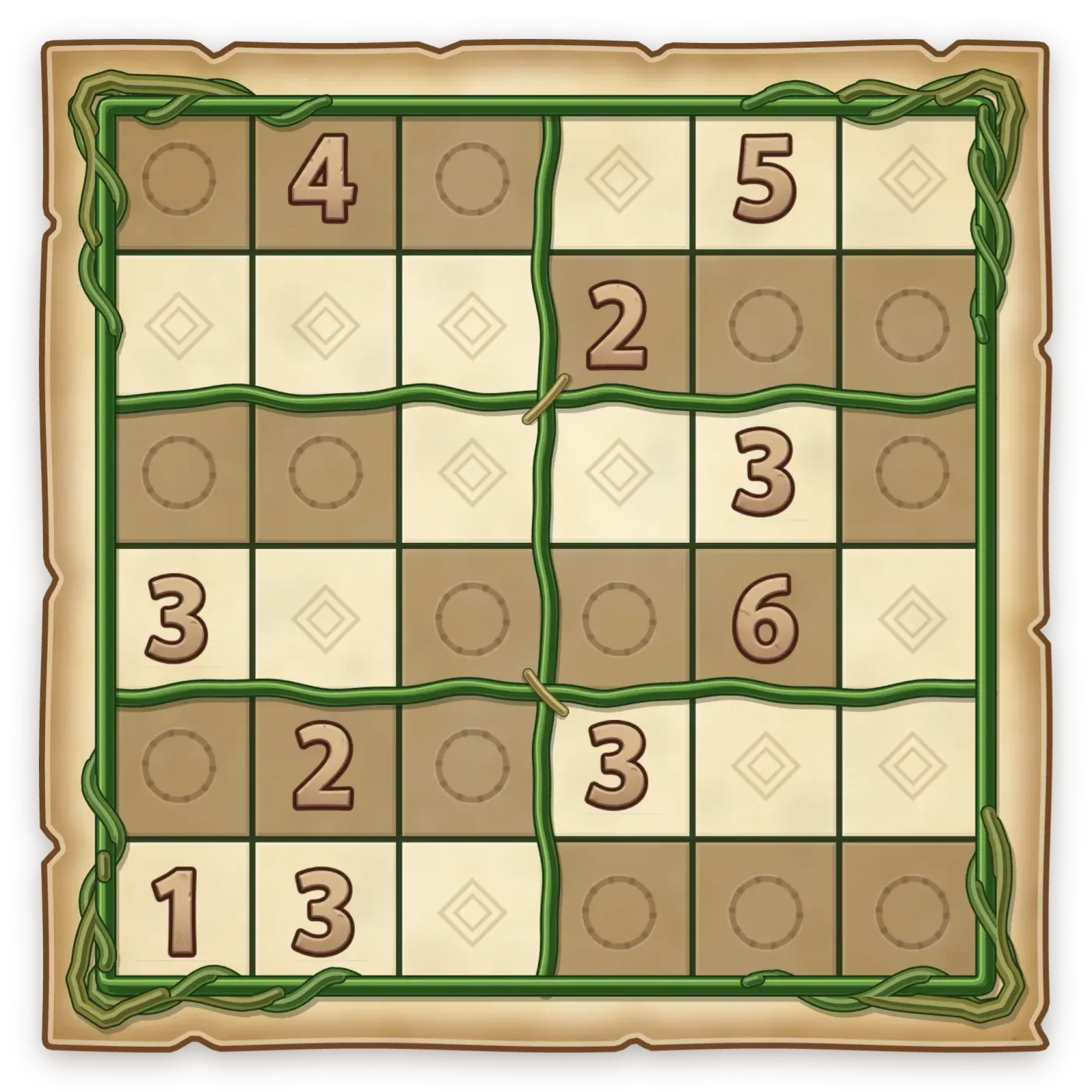
Even-odd sudoku. Circles demand even digits, diamonds demand odd ones, and unmarked cells follow standard rules.
2. Greater-than sudoku: inequalities replace givens
Greater-than sudoku (frequently called inequality sudoku) places inequality symbols (> and <) between adjacent cells. The open end of the sign always points toward the larger number. Many greater-than puzzles feature no starting digits at all: the inequality signs alone carry the entire logic of the board.
The key solving technique involves tracing inequality chains to narrow numeric bounds. If cell A is greater than B, and B is greater than C, you have an ordered sequence of three distinct digits. This means cell A cannot be 1 or 2 (it must be at least 3), while cell C cannot be 8 or 9 (it is at most 7). The longer the chain, the tighter the boundaries become: in a five-cell chain, the highest cell must be at least 5 and the lowest at most 5. Cells with multiple inequality signs pointing away from them are forced toward higher numbers, quickly unlocking deductions without trial and error.
Difficulty ranges from medium to hard. While the rules are straightforward, keeping track of interconnected relationships across the grid requires steady focus, as a single missed sign can derail the solve later on.
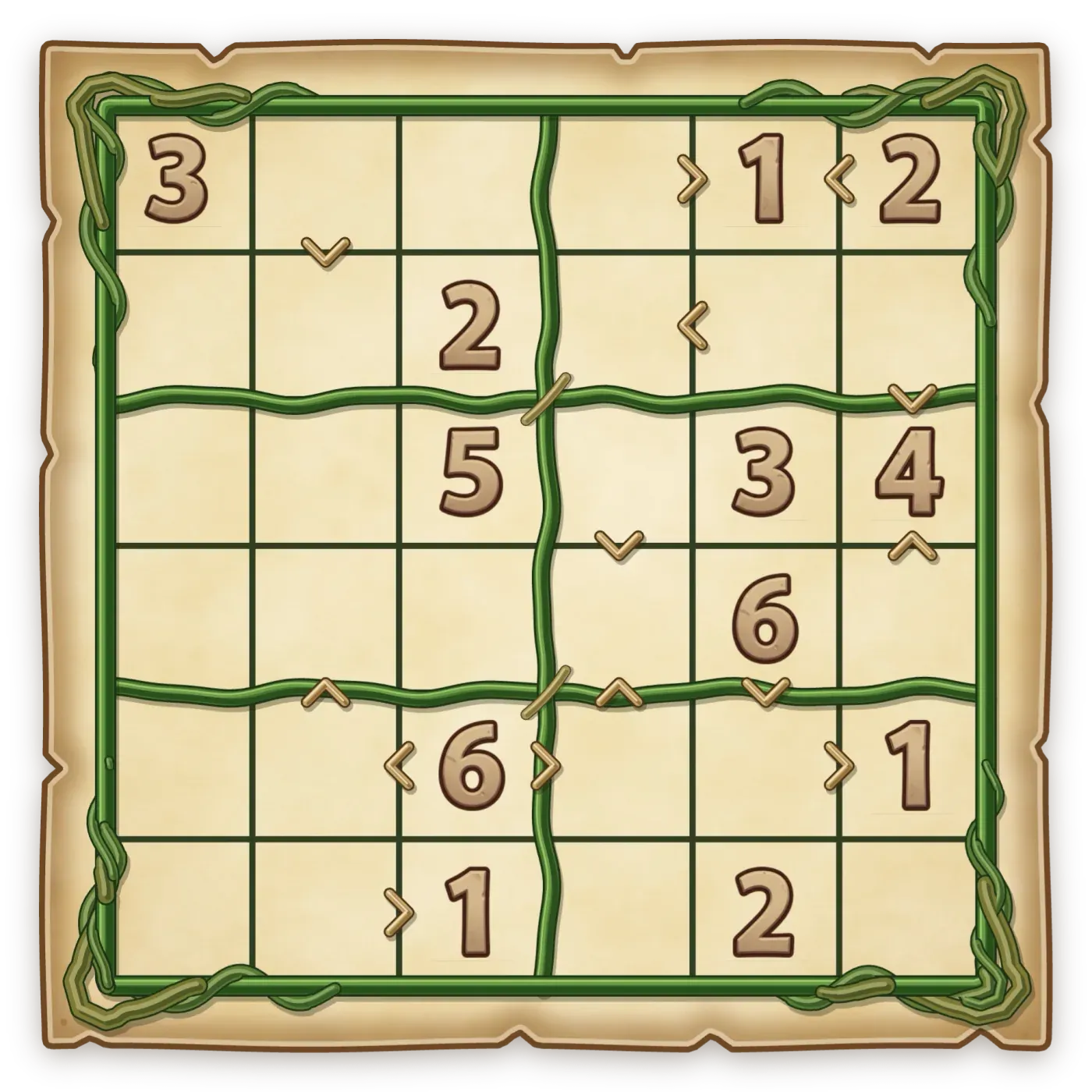
Greater-than sudoku. Inequality signs between cells establish strict numerical relationships.
3. Killer sudoku: cages with sum totals
Killer sudoku blends classic sudoku with the arithmetic deductions of kakuro. Instead of standard starting digits, the grid features cages (groups of cells bounded by dashed lines), each displaying a small sum in the corner. Digits inside a cage must add up to that total, and by standard rule, digits cannot repeat within the same cage.
The puzzle was popularized by Japanese setter Tetsuya Nishio, who built upon an idea by his student Miyuki Nisawa. British newspaper The Times introduced killer sudoku in 2005 during the peak of the worldwide sudoku boom, turning it into an enduring favorite among puzzle enthusiasts.
Solving a killer puzzle relies on two essential tactics. First, unique sum combinations: a two-cell cage summing to 3 is always {1, 2}, a two-cell 17 must be {8, 9}, and a three-cell 6 is always {1, 2, 3}. Recognizing these fixed sets immediately narrows down candidates. Second, the 45 rule: every full row, column, and block in a 9x9 grid sums to exactly 45 (the sum of 1 through 9). When you compare this known total of 45 with the sum of all cages that sit inside a given row or block, the difference instantly reveals the exact value of any cell that extends outside that boundary.
Difficulty runs from medium to expert. Killer sudoku rules do not demand advanced mathematics: success comes from combining simple addition with disciplined logic.
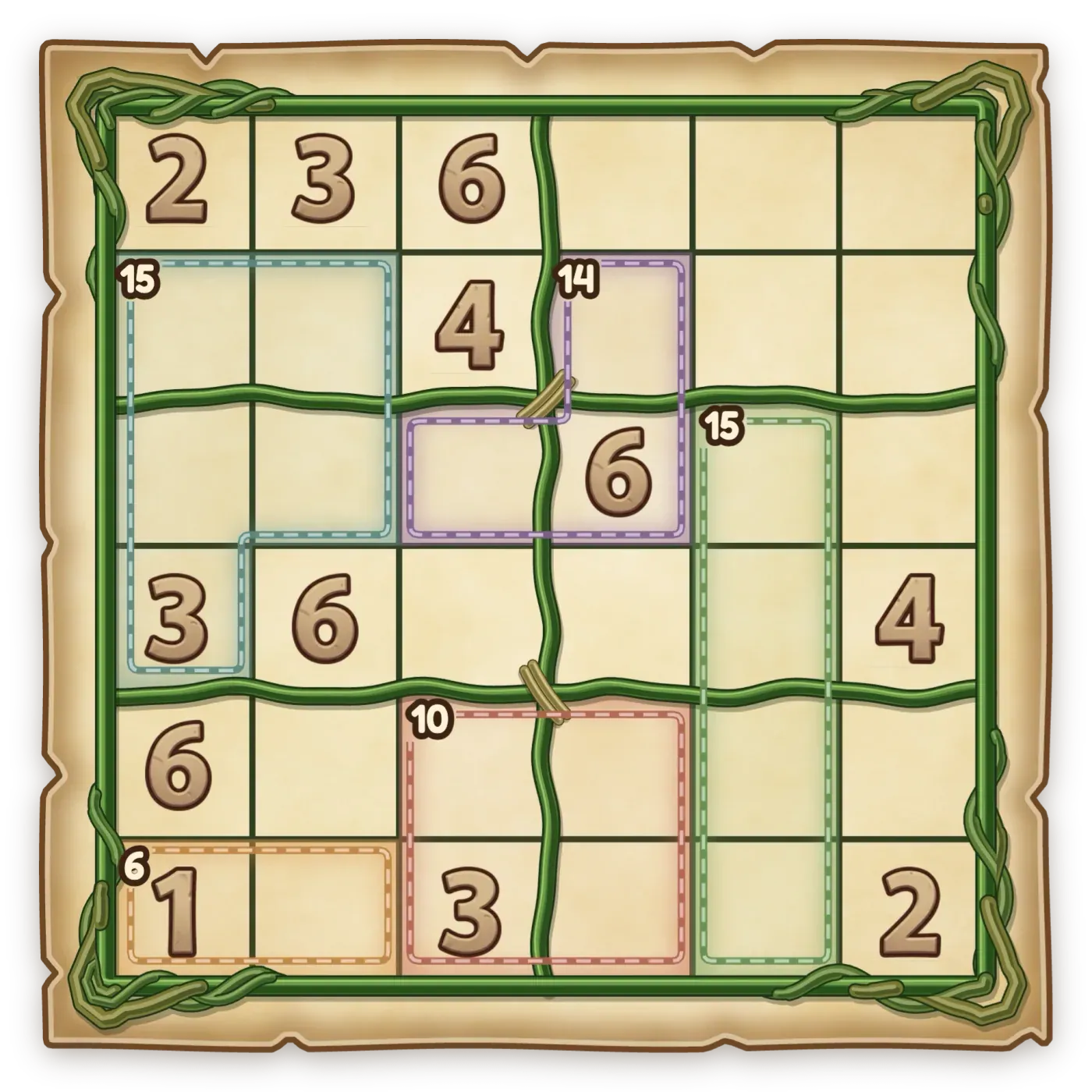
Killer sudoku. Digits in each cage must reach the designated sum without repetition.
4. Thermo sudoku: strictly increasing lines
Thermo sudoku introduces thermometer shapes across the grid, each featuring a circular bulb at one end and a line running through adjacent cells. Digits along a thermometer must strictly increase as they move away from the bulb toward the tip. Digits do not have to be consecutive (a path such as 1-3-6-9 is valid), but each step along the line must be higher than the last.
The core deduction method is identifying minimum and maximum bounds for thermometer cells. A bulb can never hold a high digit, because subsequent cells must hold strictly larger numbers. On a 9x9 board, a four-cell thermometer forces the bulb to be at most 6, while the tip must be at least 4. In addition, when a thermometer passes through a row or box, it claims specific values in order, significantly constraining where remaining high and low digits can go in that area.
Thermo sudoku grew into an online sensation largely through Cracking The Cryptic, where hosts Simon Anthony and Mark Goodliffe introduced millions of solvers to hand-crafted variant puzzles. Thermo grids generally sit at medium to hard difficulty and offer some of the most rewarding deductive breakthroughs in logic puzzles.
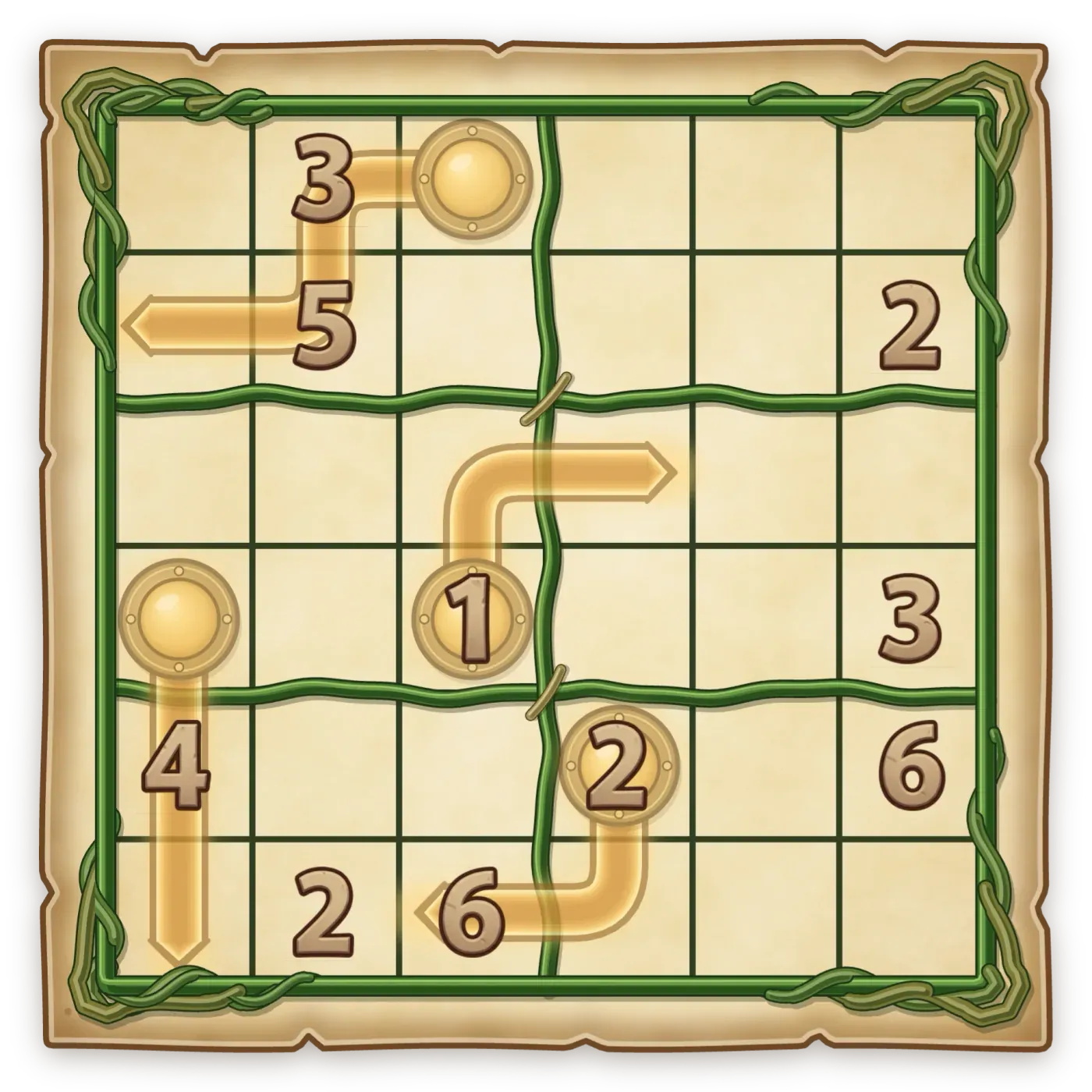
Thermo sudoku. Digits climb strictly from bulb to tip, creating clear constraints across lines and boxes.
5. Jigsaw sudoku: irregular box shapes
Jigsaw sudoku (also known as irregular sudoku or nonomino) keeps all standard rules intact: every row, column, and region must contain the digits 1 through 9 without repeats. The distinction is visual and geometric: instead of tidy 3x3 square boxes, the grid is divided into nine irregular, interlocking shapes of nine cells each.
This variant emerged during the 2004-2005 boom as publishers sought fresh ways to challenge experienced solvers. Color-coding each irregular region turned what could have been a visually cluttered puzzle into an elegant, engaging board.
The defining tactic of jigsaw puzzles is the Law of Leftovers. Consider a group of complete rows, such as the top two rows, which together must contain two complete sets of digits 1 through 9. When you examine the jigsaw regions overlapping those two rows, some cells will spill over into the third row. By simple conservation, the cells sticking out must contain the exact same set of digits as the missing cells needed to complete the regions inside the top rows. This geometric property often hands you confirmed digits without complex candidate tracking.
Difficulty sits between medium and hard. Because regions wrap around corners and stretch across multiple lines, scanning requires different visual habits than standard sudoku, creating a refreshing challenge.
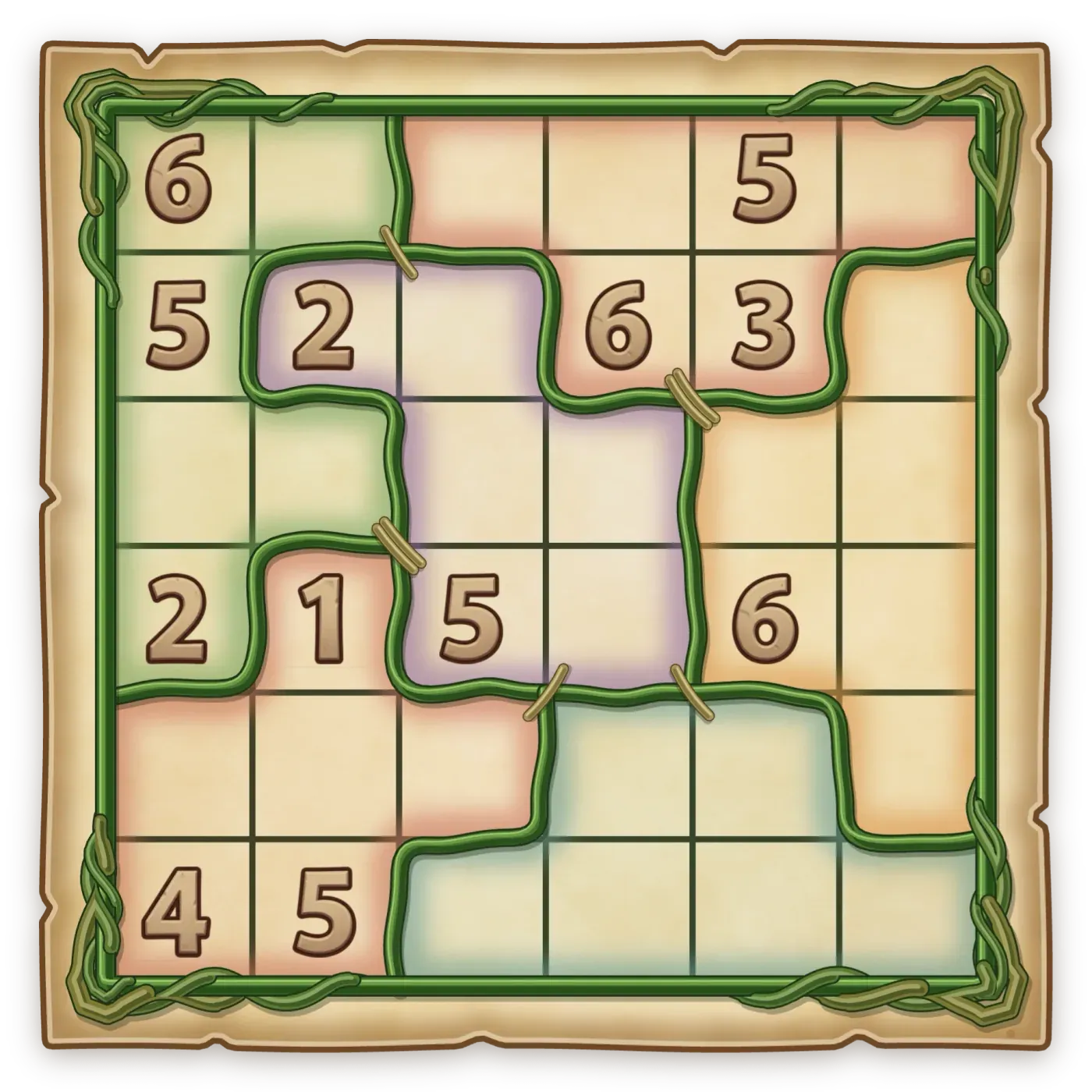
Jigsaw sudoku. Standard logic applies, but irregular nine-cell shapes replace the regular 3x3 boxes.
6. Twodoku: two interconnected grids
Twodoku belongs to the multi-grid puzzle category (often called gattai in Japan). Two full 9x9 sudoku grids overlap so that they share a single 3x3 corner block. Each individual grid obeys classic sudoku rules, while the shared cells must satisfy the row, column, and block requirements for both grids simultaneously.
The winning approach is active clue propagation through the shared region. The overlap is the most constrained part of the entire board. In a well-constructed twodoku, neither grid can be completed independently: deductions in one grid help populate the shared block, which in turn unlocks candidate eliminations in the neighboring grid. When progress stalls on one board, switching focus to the other usually provides the missing link.
A well-known larger relative of twodoku is samurai sudoku, which connects four corner grids to a central 9x9 board. Twodoku offers a more concise, approachable entry point into multi-grid solving. Difficulty is medium to hard, primarily due to the coordination needed between both grids.
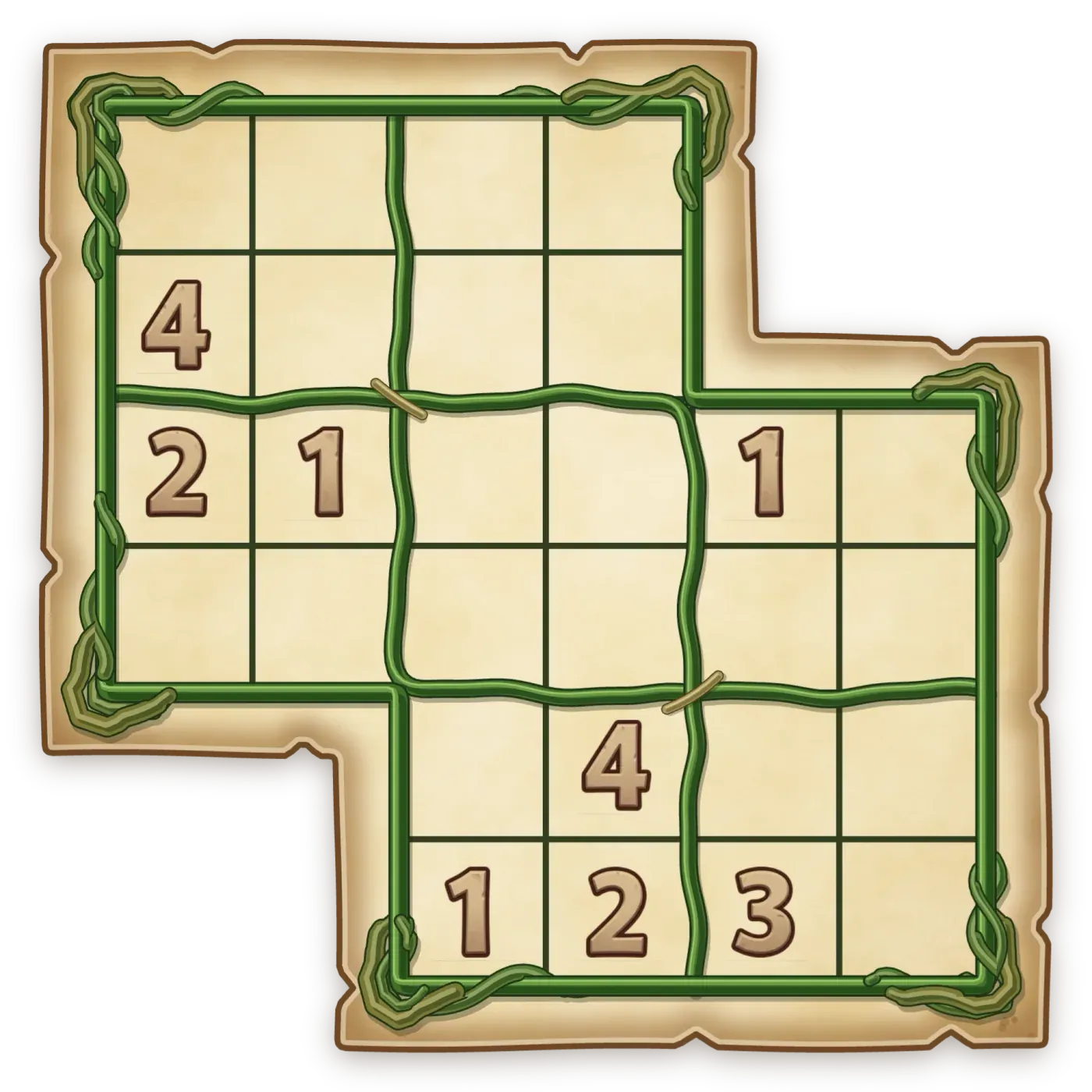
Twodoku. Two grids share a corner block, and digits in the overlap must satisfy both boards.
7. Flower sudoku: five interconnected grids
Flower sudoku is an expansive multi-grid variant featuring five overlapping 9x9 grids: four outer grids surround a central grid like petals. Unlike samurai sudoku, where grids only touch at their outer corners, flower sudoku features much deeper overlaps, with the central grid largely covered by the surrounding four boards. The configuration was introduced in 2006 and popularized on puzzle sites such as Djape’s blog.
The most effective strategy is using the outer grids to steadily resolve the center. Because so much of the central board is shared with the outer petals, every digit placed in an overlap region directly restricts possibilities in the center. Experienced solvers work inward from the outer perimeters, driving candidate eliminations toward the middle. As the central grid fills in, it reflects new clues back outward into the remaining grids.
Flower sudoku is the most demanding variant on this list. Completing a full puzzle requires patience, disciplined scanning, and constant cross-checking between all five grids, resulting in an immensely satisfying finish.
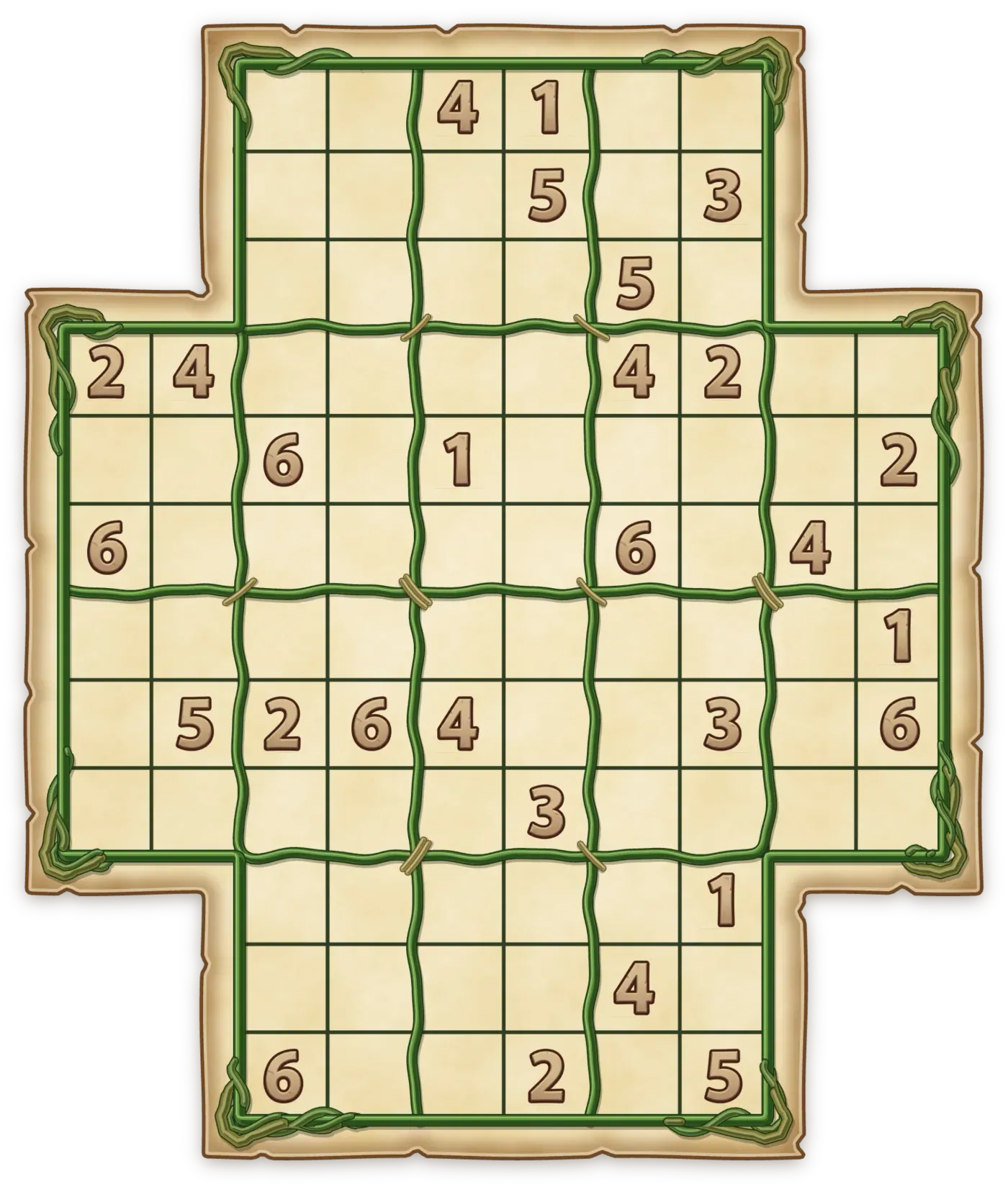
Flower sudoku. Five deeply overlapping grids create a rich network of interconnected deductions.
Which sudoku variant should you try first?
If you are new to variant puzzles, begin with classic sudoku to solidify the fundamentals, then try even-odd sudoku. Parity markers provide a gentle introduction to candidate filtering without complicating the solving process.
Players who enjoy mental math will naturally gravitate toward killer sudoku, where arithmetic and the 45 rule drive the deductions. If you prefer spatial and visual thinking, jigsaw sudoku offers a great test of pattern recognition. For pure deductive depth with minimal extra notation, greater-than and thermo sudoku deliver rich logic with very few additional rules. Finally, if you enjoy long, immersive puzzle sessions, twodoku and flower sudoku provide the ultimate marathon challenges.
Frequently asked questions
How many types of sudoku exist? There is no fixed limit, as puzzle setters continually invent new variations. Beyond the eight types covered in this guide, popular options include diagonal sudoku (where digits cannot repeat along main diagonals), sandwich sudoku, arrow sudoku, and palindrome sudoku. You can explore a broader list in the Wikipedia overview of sudoku variants.
Which sudoku variant is the easiest? Even-odd sudoku, followed closely by classic sudoku on easy difficulty. Knowing whether a cell is even or odd immediately eliminates roughly half of all candidates, making early placements much faster.
Which sudoku variant is the hardest? Multi-grid layouts such as flower and samurai sudoku rank among the most difficult due to their sheer scale and interconnected dependencies. Among single-grid variants, advanced killer and thermo sudoku puzzles require the deepest multi-step candidate deductions.
Does killer sudoku require advanced math? No. It only requires basic addition within 45. The challenge lies in deductive logic and identifying unique number sets rather than performing complex calculations.
Can I use classic sudoku techniques in variants? Yes. Core strategies such as naked singles, hidden singles, pairs, pointing sets, and X-Wings apply across all variants. The variant rules simply give you additional tools to eliminate candidates and confirm numbers.
Where can I play all eight types? In Polydocu, our mobile adventure that blends classic logic puzzles with an engaging jungle expedition. The game includes classic, even-odd, greater-than, killer, thermo, jigsaw, twodoku, and flower boards, along with daily quests and Poly the parrot keeping score.
Try every type in Polydocu
All eight boards featured in this article come directly from Polydocu, the sudoku adventure game developed by Psittacus Studio. We brought together eight distinctive variants into a cohesive jungle journey, ranging from relaxed introductory puzzles to complex multi-grid challenges. The game is launching soon on iOS and Android.
Join the waitlist to receive an update the moment Polydocu becomes available.
Recommended reading: discover the real history of sudoku, read our complete guide to solving techniques, explore the oldest games in the world, and train your working memory with our guide to the memory palace and mnemonic techniques.
Sources
- Sudoku, Wikipedia: history of the classic puzzle and the 2005 variant boom
- Killer sudoku, Wikipedia: Tetsuya Nishio, Miyuki Nisawa, and the origin of sum-based sudoku
- Cracking The Cryptic, Wikipedia: the channel that brought modern variant sudoku to a worldwide audience
- The History of Jigsaw Sudoku, The Puzzle Labs: the emergence of irregular-shaped sudoku regions
- Gattai and overlapping sudoku, Cross Plus A: multi-grid puzzle structures and overlapping board conventions
- Flower Sudoku, Djape: history and mechanics of the 2006 flower layout
- Even/Odd Sudoku rules, Grandmaster Puzzles: common conventions for parity-based sudoku
- How to Play Jigsaw Sudoku, Sudoku by Joseph: detailed walkthrough of the Law of Leftovers
- Jak rozwiązywać sudoku, Poziomo-Pionowo: classic solving techniques and terminology
Polydocu - a sudoku adventure
Nine digits, an expedition through the jungle, Poly the parrot, and no artificial roadblocks. Join the waitlist and we will notify you when the game launches.
One email at launch, no spam.