Sudoku With Others: 5 Ways to Play Together, From Duels to Family Tournaments
Sudoku is not just a solo hobby. Discover 5 practical formats to solve together: timed duels, a family tournament, multigenerational play, and clubs.

Published on 14 min
On this page
Most players treat sudoku as a solitary ritual: one pencil, one printed grid, and absolute silence. That solitary habit misses what makes the 9x9 board special. The exact same logic puzzle can anchor a focused date night, energize a multi-round family tournament, or open a natural conversation with older relatives. The rules remain unchanged. You only change how many people share the table.
This guide provides five battle-tested formats for shared play. Each format targets a distinct dynamic: cooperative problem-solving as a pair, high-stakes head-to-head racing against a timer, structured multigenerational tournaments, and a recurring workplace or school club. Every section delivers complete rules, transparent scoring systems, and practical tips you can put into practice immediately.
Format comparison at a glance
Use this quick summary to pick the right format based on your group size, available time, and skill balance.
| Format | Players | Core focus | Setup required |
|---|---|---|---|
| Pair solving | 2 | Shared deduction and teamwork | Minimal (1 sheet, 2 pencils) |
| Timed duel | 2 | Speed, precision under clock pressure | 2 identical grids or the same digital seed |
| Family tournament | 3-12 | Balanced multigenerational competition | Multiple grid sizes (4x4, 6x6, 9x9) |
| Playing with seniors | 2-4 | Mental workout and conversation | High contrast, large print, untimed |
| Puzzle club | 4-20 | Community building and habit | Weekly slot, puzzle of the day, leaderboard |
1. Solving sudoku as a pair: 5 cooperative styles for one board
Sharing a single sheet of paper can turn chaotic if two solvers fight over the pencil. When you establish clear boundaries beforehand, a pair solves faster and spots deductions more reliably than a solo player. Two pairs of eyes scan intersections in half the time, and explaining a move out loud stops reckless guessing in its tracks. Here are five cooperative variants, arranged from easiest to most advanced.
Alternate turns
Solvers take turns entering one digit at a time. The core rule is non-negotiable: every entry must rely on deductive certainty. When you write a number, your partner can ask for the exact logical reason why no other digit fits that cell. If both of you get stuck, you scan the grid together, but the physical write-in remains with the person whose turn it is. This rhythm builds mental discipline and strips away impulsive guesswork.
Zone division
A standard 9x9 grid contains nine 3x3 boxes. Divide the grid evenly: each solver takes responsibility for four assigned boxes, while the central box remains neutral territory solved together. The real collaboration sparks at zone borders. When an open row sweeps across both players’ sectors, you must coordinate candidate possibilities across the boundary. This structure serves as active practice for naked singles, a core technique we break down in our complete guide to solving sudoku.
Mentor and apprentice
This format bridges the gap when one player has solved hundreds of grids while the other is just beginning. The experienced solver never writes in digits directly. Instead, they vocalize their analytical process: “Look at the bottom-right box. We still need a 3 and an 8. This row already contains an 8, so where does the 3 have to go?” The beginner connects the dots, verifies the elimination, and makes the entry. This dynamic builds confidence without depriving the new player of genuine breakthroughs. That balance between guidance and independence drives the progression in our upcoming game Polydocu, where contextual clues teach strategic deduction without taking control away from the player.
Two identical grids with retrospective review
Both players tackle the exact same puzzle simultaneously on separate sheets without a running timer. Once both finish, you compare your paths: where you hit your first dead end, which candidate technique unlocked the grid, and where errors occurred. For pairs with mismatched experience, apply a simple handicap: the advanced player solves without pencil marks, while the beginner uses full candidate notation.
Shared grid with two colors
One board and two pens in contrasting colors, such as blue and green. Every entered digit and every pencil mark shows who discovered it. At the end of the game, a single look at the sheet reveals each player’s contribution. Japanese puzzle enthusiasts describe this as an energetic rhythm: digits land on the board before you spot them yourself, opening fresh avenues across your own sectors.
2. Head-to-head racing: rules for competitive sudoku duels
Sudoku creates a pure competitive arena because it leaves no room for luck. There are no dice, no random card draws, and no hidden information. Victory hinges entirely on pattern recognition speed, clean elimination, and emotional control while watching your opponent fill cells in real time.
Speed solving has thrived since the inaugural World Sudoku Championship. You can run that same tournament-level excitement at your kitchen table with this battle-tested ruleset.
Tournament duel protocol
- Identical puzzle material. Both solvers must work on the exact same starting configuration. If you use paper, print two copies from the identical source file. If you use software, verify that both devices load the same random seed.
- Standardized notation rules. Agree before the countdown whether pencil marks are allowed. Combining mental-only solving with full candidate notation skews the outcome, as pencil marks fundamentally change solving pacing.
- Strict penalty system. Guessing destroys the spirit of sudoku and demands firm consequences in a duel. Choose between two proven penalty systems:
- Time penalty: Every incorrect digit identified during post-game verification adds 30 penalty seconds to that player’s total time.
- Three-strikes disqualification: A player who enters three invalid digits forfeits the match immediately.
- Skill handicaps. When players have different experience levels, level the playing field before starting. The stronger solver can concede a 60-second head start, or reveal three additional given numbers on the challenger’s board.
- Best-of-three series. A single race can hinge on an accidental visual scan. A best-of-three match delivers a true test of consistency and concentration.
A strategic tip from tournament veterans: dedicate your first 15 seconds to a quiet visual scan across all nine boxes. Identify the most frequent starting digits and clear the obvious single candidates before speeding up. A racer who writes numbers in the opening second without reading the whole board almost always walks into an avoidable penalty.
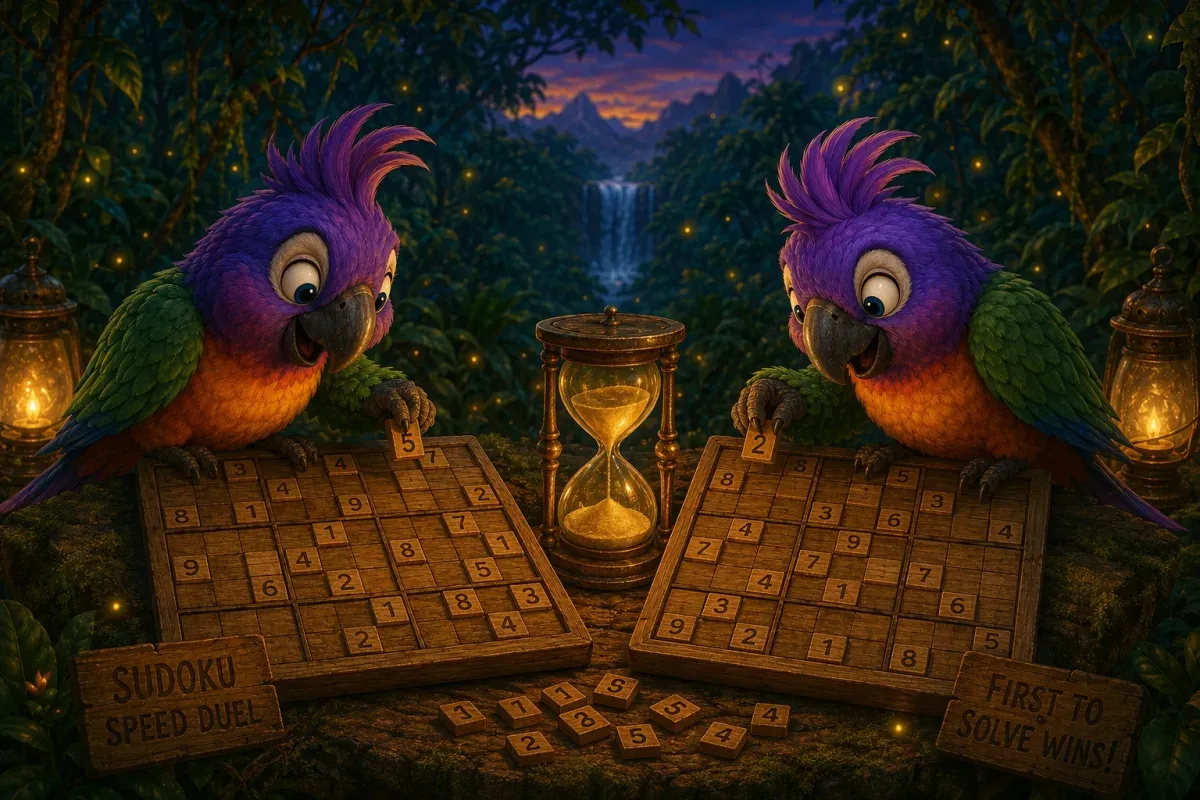
Duel format: two identical boards, one hourglass timer, and zero tolerance for speculative guessing.
3. How to organize a family sudoku tournament
Organizing a tournament for family or friends takes minimal preparation and yields memorable moments. You do not need to create tournament formats from scratch. Poland offers an inspiring real-world blueprint: the Lower Silesia Sudoku Championship, organized annually by Wrocław University of Science and Technology. That event brings together elite competitors alongside multi-generational family squads competing as teams.
Here is a turnkey schedule designed for a two-hour event accommodating four to twelve players.
Tournament round schedule
- Round 1: Warm-up (15 minutes). Everyone receives an easy, accessible grid. Scores in this round do not count toward the championship table. The goal is to calibrate everyone to the pencil-and-paper environment and confirm that all players grasp the validation rules.
- Round 2: Age-graded division (30 minutes). Participants receive puzzles calibrated to their experience:
- Children under 9: 4x4 grids featuring numbers 1 to 4 or colored shapes.
- Juniors aged 10-14: 6x6 grids.
- Adults and seniors: standard 9x9 grids at an easy or medium difficulty tier.
- Round 3: Team relay (25 minutes). The rowdiest and most entertaining segment. Form teams of two or three. Only one team member sits at the solving table at any moment. After entering one valid digit, that player tags their teammate, who rushes in to make the next deduction. The relay forces each solver to interpret a teammate’s logic in seconds.
- The Grand Final (20 minutes). The top two individual solvers and the top two relay teams receive an identical medium-tier puzzle, solving head-to-head while the rest of the room watches and cheers.
Transparent tournament scoring
Keep scoring objective with this mathematical rubric:
- Base points: 10 points for every fully completed, verified grid within the round time limit.
- Speed bonus: 1 bonus point for each full minute remaining on the clock upon submission.
- Partial credit: If a solver does not finish before time expires, grant 1 point for every verified correct digit, provided the grid contains zero logic errors.
- Error deduction: Deduct 2 points for every incorrect digit left on a submitted sheet.
Simple trophies carry the most charm: a paperboard cup, a painted wooden medal, and the title of Family Sudoku Champion until the next gathering. Keep a folder of lighter brainteasers on a side table so players who miss the final round can continue solving together without feeling sidelined.
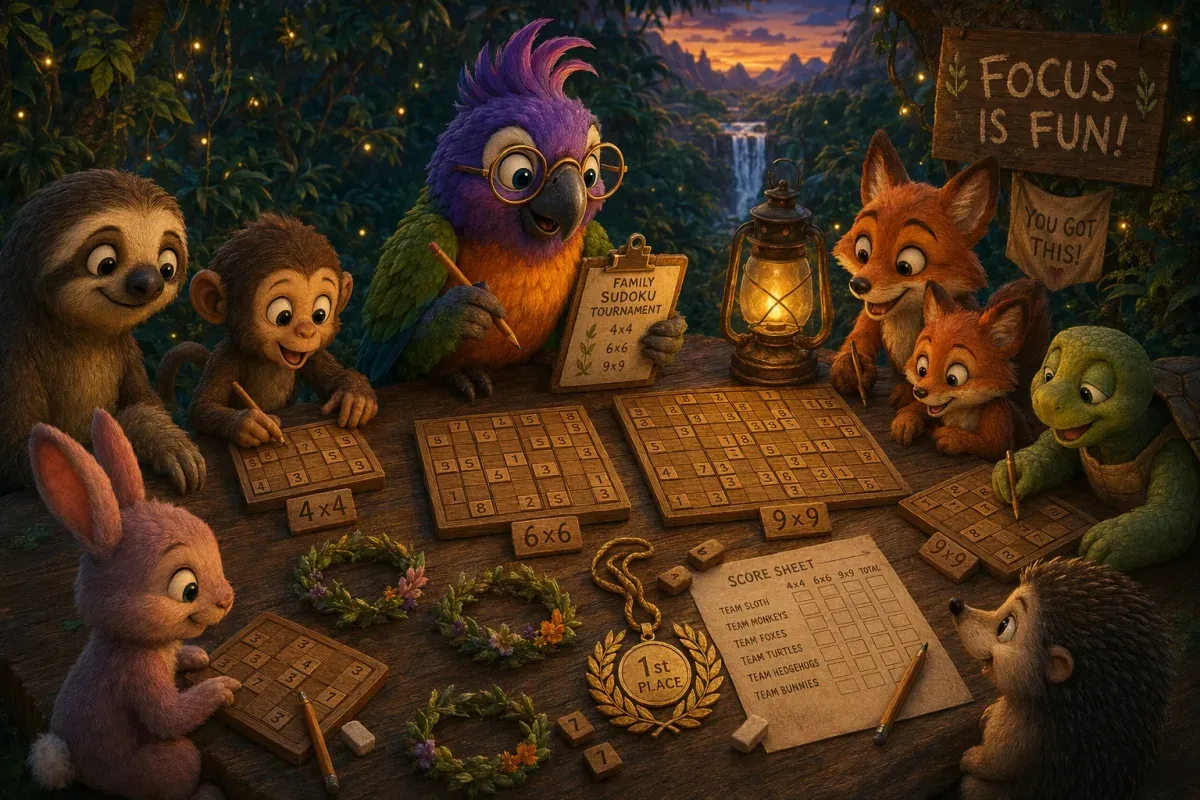
Family tournament setup: age-tailored puzzle sizes, clear scorecards, and friendly competition.
4. Sudoku with seniors: cognitive stimulation and shared time
Sudoku is one of the few pastimes where an eighty-year-old and an eight-year-old meet on equal footing. Logic grids require no trivia recall, no physical agility, and no mastery of smartphone settings. The fairness comes directly from the board’s transparent rules.
To make sessions with older relatives rewarding and comfortable, apply these practical recommendations:
- Prioritize physical ergonomics. Newspaper puzzles use small typefaces and low-contrast newsprint that strain aging eyesight. Print custom A4 sheets with enlarged cells, heavy grid lines separating the 3x3 boxes, and sharp, high-contrast numerals.
- Start with intermediate dimensions. Rather than jumping straight into a dense 9x9 puzzle, warm up on a 6x6 grid. A clean, quick victory sets a positive emotional tone for the afternoon.
- Work cooperatively against the puzzle. Avoid stressful timers. Place the grid centrally, talk through possibilities, and verify candidates as partners.
- Use the completed grid to open conversations. Once the final number is in place, do not immediately file the paper away. Ask: “Which breakthrough opened up the grid for you?” That simple prompt shifts attention away from mechanics and invites shared stories and reflection.
What scientific research actually says
Popular media often exaggerates the health benefits of logic puzzles, making it crucial to examine rigorous research. A milestone study led by Dr. Anne Brooker, analyzing 19,078 participants aged 50 and older, confirmed a statistically significant relationship: individuals who regularly solved number puzzles scored higher on standardized tests assessing attention, working memory, and logical reasoning.
Independent scientific bodies, including the Science Media Centre, caution against overstating these findings: solving sudoku does not cure or prevent neurodegeneratives diseases or dementia. Look at the research realistically: sudoku serves as active mental exercise and an enriching social bridge, not a medical treatment.
5. How to start a sudoku club at work, school, or your local library
A successful puzzle club requires neither a large budget nor administrative overhead. Its success rests entirely on regularity: one dependable table, one predictable time slot each week, and a fresh puzzle ready to solve.
Follow these proven pillars to build an active community:
- Frictionless drop-in policy. Keep attendance informal. Solvers must feel comfortable dropping in for ten minutes during lunch or leaving early without formal sign-ups or attendance tracking.
- The Puzzle of the Day anchor. Open each session by handing everyone the identical challenge. After 15 minutes, gather around a whiteboard to review difficult cells and discuss alternative deduction paths. This shared focal point connects newcomers with seasoned solvers.
- The community puzzle shelf. In an office breakroom or school library, set up a dedicated station: a binder of printed grids sorted into three difficulty levels and a drop box for completed sheets.
- A balanced monthly leaderboard. A bulletin board tracking results sparks playful motivation. Make sure to reward consistency: give points for total puzzles completed during the month alongside raw speed records.
For inspiration, look to the history of the Japanese publishing house Nikoli. Over four decades, Nikoli cultivated a worldwide community through handcrafted logic puzzles. Their core insight remains timeless: the printed puzzle is an invitation, but the genuine reward is human connection and shared intellectual joy.
Decision guide: which format fits your moment?
Use this quick reference to decide your next move:
- Twenty minutes with a partner? Run a head-to-head duel or an alternating single-sheet solve.
- Teaching someone logical deduction? Use the mentor-apprentice dynamic or compare separate solves after the clock stops.
- Hosting a weekend family gathering? Stage a multi-round tournament with team relays and age-graded boards.
- Spending quality time with older relatives? Choose cooperative solving on an enlarged 6x6 print without a timer.
- Looking to connect with coworkers or classmates? Launch a weekly club anchored by a Puzzle of the Day.
Frequently asked questions (FAQ)
Can two people solve a sudoku puzzle together on one board?
Yes. The most effective formats include alternating entries, dividing the grid into assigned 3x3 boxes, and using two distinct colored pens to track deductions. Clear ground rules prevent solvers from writing over each other.
How do you run an impartial sudoku race?
Ensure both participants work from identical starting boards and agree on notation rules beforehand. Introduce time penalties for invalid digits, such as 30 penalty seconds per error, and offer handicaps when skill levels differ.
At what age can children participate in a family tournament?
Children as young as 5 can solve 4x4 grids using numbers or color symbols, while primary school students quickly grasp 6x6 layouts. This progression lets grandparents, parents, and young kids share the exact same tournament table.
Does playing sudoku protect against cognitive decline?
Peer-reviewed studies indicate that adults over 50 who regularly engage with number puzzles exhibit stronger cognitive metrics in attention and executive function. However, medical researchers emphasize that puzzles do not provide clinical immunity against dementia.
Where can friends play multiplayer sudoku online?
Several specialized platforms host real-time multiplayer sudoku rooms where two or more players race on synchronized boards. For casual sessions, a simple video call with matching printed sheets works just as well.
Try Polydocu together
In our upcoming title Polydocu, we merge traditional sudoku logic with an expedition through an uncharted jungle. The game features solo progression alongside friendly multiplayer challenges, daily puzzles, and global leaderboards where you can test your speed against friends. Poly, our resident parrot, oversees every grid to ensure logic rules every move.
Join the waitlist to receive launch notifications on iOS and Android the moment the expedition begins.
Recommended reading
To deepen your logic puzzle knowledge, read our history of sudoku, master foundational solving methods in our complete guide to solving sudoku, discover eight fascinating sudoku variants, and learn why fundamental games have survived for millennia in our exploration of the oldest games in the world.
Sources
- World Sudoku Championship, Wikipedia: international tournament structure, sprint rounds, team relays, and world records.
- Brooker et al., The relationship between the frequency of number-puzzle use and baseline cognitive function, International Journal of Geriatric Psychiatry 2019: observational study of 19,078 older adults evaluating number puzzle habits and cognitive health.
- Expert reaction to studies on word and number puzzles, Science Media Centre: independent expert analysis of puzzle research methodologies.
- Crosswords and Sudoku do not protect against dementia, RMF24: clinical review evaluating mental exercises in neurodegenerative care.
- Lower Silesia Sudoku Championship, Wrocław University of Science and Technology: organization and rules of a multi-tiered regional sudoku event.
- Polish Sudoku Championship, Sfinks Foundation: official tournament regulations and online qualifying formats.
- Daily Sudoku Together: Two Ways to Play With Friends, Pure Sudoku: analysis of collaborative and competitive shared play modes.
- Multiplayer Sudoku Online, SudokuLeader: web platform for 1v1 duels and multi-seat digital solving rooms.
- Sudoku Battle With Friends, SudoBattle: opening tactics and strike-based error systems for speed duels.
- Inside Japan’s Cult-Favorite Puzzle Laboratory, Atlas Obscura: retrospective on Nikoli and community building around handcrafted puzzles.
- Friendly multiplayer mechanics in number puzzles, note.com: player perspective on team problem-solving dynamics.
- Sudoku in the Library, Vocational School Complex Opole and Interschool Sudoku Tournament, SP4 Orzesze: real-world educational tournaments and library club structures.
Polydocu - a sudoku adventure
Nine digits, an expedition through the jungle, Poly the parrot, and no artificial roadblocks. Join the waitlist and we will notify you when the game launches.
One email at launch, no spam.