Why Puzzle Games Still Rule Mobile: Market Trends and One Very Clever Parrot
Mobile puzzle games earned $10 billion in 2025 and Poland plays mostly on phones. Casual vs hyper-casual, cozy games, and what parrots teach game designers.

Published on Updated on 9 min
On this page
In 1977, Irene Pepperberg, a Harvard doctoral student, bought a young African grey parrot (Psittacus erithacus) at a Chicago pet shop. She named him Alex. Over the next thirty years, Alex learned to identify colors and shapes, counted up to six, and understood the concept of zero. When he grew tired of testing sessions, he would deliberately give wrong answers just to prompt the researchers to wrap up. Wikipedia chronicles his life, and Audubon highlights how Pepperberg’s research reshaped scientific understanding of avian intelligence.
In our Poznan studio, we see an interesting parallel: parrots and well-designed puzzle games both demand respect for cognitive skill. A player who enjoys solving puzzles will instantly spot artificial barriers or manipulative mechanics. At Psittacus, we never treat players like wallets to be emptied. We treat them as smart, curious individuals who appreciate a thoughtfully crafted game. Here is what industry data reveals about this approach, and how it guides the sudoku adventure we are building.
Puzzle games as the most resilient mobile genre
Puzzle games remain one of the healthiest, most consistent segments of mobile gaming. In 2025, mobile puzzle titles generated roughly $10 billion in in-app purchase revenue across 9.7 billion downloads, marking a 14 percent year-over-year increase. Data from AppMagic paints a similar picture, valuing the genre at $8.8 billion with a 14.7 percent rise. According to Sensor Tower, puzzle revenue grew by 21 percent in the fourth quarter of 2025 alone. Together with strategy titles, puzzles captured 45 percent of all player spending in mobile apps. When mobile users choose to invest money in games, they prioritize meaningful, brain-stimulating experiences.
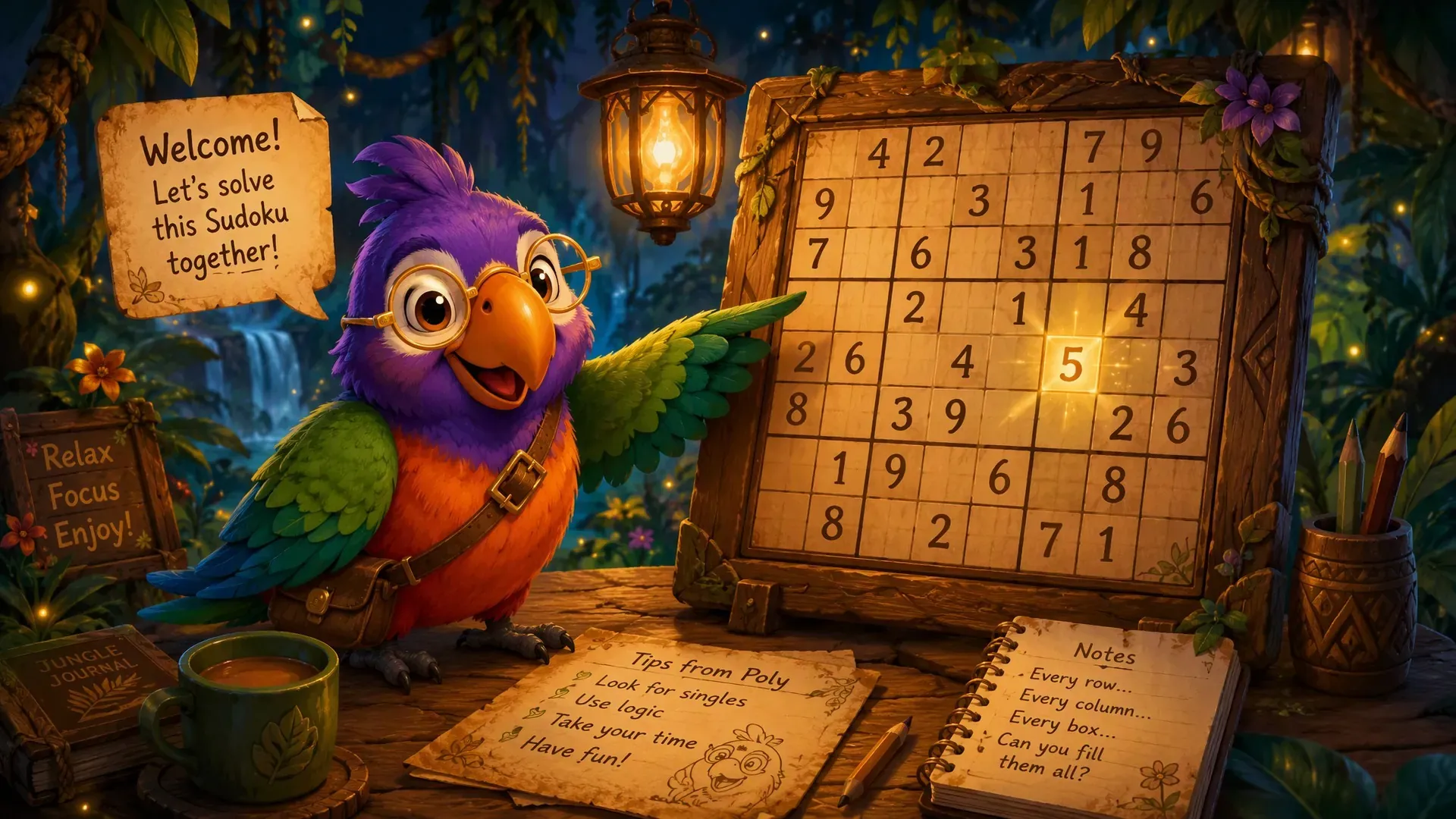
Engagement figures back this up. The Sensor Tower State of Mobile report ranks puzzle games second only to simulation in total playtime. Puzzles fit naturally into modern life: you do not need two hours at a desk. You can solve a grid on your morning commute, lock your screen, and pick up right where you left off later that evening. The core loop is immediately clear, while meta-progression, such as saga maps and daily quests, encourages long-term enjoyment. That is the philosophy behind Polydocu: clean puzzle gameplay wrapped in a rich world. If you want a refresher on the basics, our complete sudoku guide explains the rules from scratch.
The evolution from hyper-casual to hybrid games
Hyper-casual games rely on a fast turnover: players learn the mechanic from a brief video ad, play for a few sessions, and often delete the app within a week. That business model relies on heavy ad volume and cheap acquisition. The casual market, by contrast, focuses on retention, live events, and balanced monetization. Research from Liftoff shows that the combined revenue share of hyper-casual and puzzle games among the top 500 grossing US iOS titles surged from $4.1 million to $14.0 million between late 2023 and 2024. The industry responded by embracing a hybrid formula.
The hybrid-casual model combines immediate accessibility with deeper progression systems typically found in mid-core titles. As publisher Azur Games noted on PocketGamer.biz, casual mechanics grew up. The data proves the appeal: hybrid-casual was the only segment to increase in-app purchase revenue in 2025. The recipe is straightforward: easy to learn, rewarding to master, and free of manufactured frustration.
Cozy games: comfort in your pocket
Cozy games have found a dedicated following because they offer a genuine sense of calm. Research from Sago shows that 53 percent of players choose cozy titles to unwind and decompress, while 52 percent look for gameplay without countdown stress. Nearly 40 percent play while listening to music or podcasts. This audience is not looking for high-pressure challenges, but for welcoming virtual spaces.
This dynamic suits mobile screens well. A typical session might be a working adult taking fifteen peaceful minutes before bed to relax with a game that never rushes them. We explored this trend in our look at why simple mobile games stand the test of time. Alex the parrot fits here too: intelligent animals reject repetitive, coercive tasks. Players do the same the moment a game stops valuing their time.
Transparent monetization over player fatigue
Players have not turned away from free games, but they are weary of monetization tactics that treat them like numbers in a funnel. Hard energy gates, opaque loot boxes, and artificially inflated timers burn out players and damage retention. Short-term revenue spikes rarely offset the loss of community trust.
Transparency offers a healthier alternative. A Mordor Intelligence study notes that optional rewarded video ads let free players progress steadily without feeling blocked or coerced. At Psittacus, we embed this idea in our studio guidelines, which we detail in our piece on accessible board design. We avoid dark patterns and energy limits. Poly the parrot encourages your progress rather than nudging you toward paywalls.
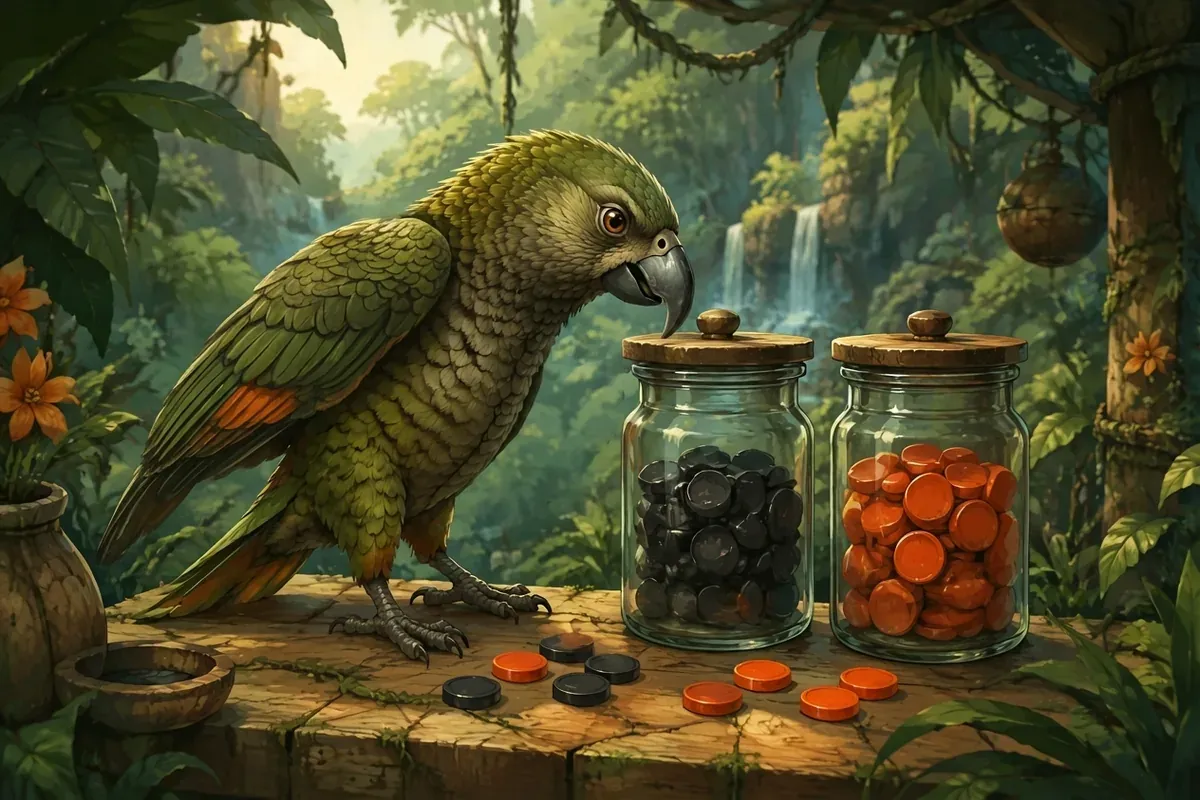
Animal cognition offers a fitting lesson here: parrots are remarkably adept at understanding odds. Research in Nature Communications demonstrated that New Zealand kea parrots can assess statistical probabilities. When observing jars containing black and orange tokens, kea consistently chose the researcher most likely to draw the rewarding color. In gaming terms, thoughtful players quickly see through unfair algorithms.
Does the market need another puzzle game?
Launching another Match-3 clone is an uphill battle. Data from AppMagic shows that only 1.4 percent of new Match-3 games passed $100,000 in monthly revenue during the first half of 2025. Two industry heavyweights, Royal Match and Candy Crush Saga, capture the vast majority of category earnings.
Yet the puzzle genre extends far beyond gem matching. During that same period, revenue from block puzzles grew twelvefold, screw-loosening puzzles nearly tripled, and sorting games doubled their market presence, sparking over 2,500 new launches across those three niches alone. Players are eager for original mechanics. As with games built by solo developers, a focused scope and a clear identity routinely outshine bloated budgets. For Polydocu, that identity centers on a lush jungle, an engaging saga trail, and Poly as your guide.
Mobile gaming in Poland and Central Europe
Poland provides a clear illustration of mobile gaming dominance. The GameTrack 2025 study by Video Games Poland, reported on PPE, found that roughly 15.9 million people in Poland play video games, representing half the population aged 6 to 75. Smartphones lead decisively: 84 percent of Polish gamers play on mobile devices, compared to 33 percent on consoles. The overall market is valued at 5.16 billion PLN, with mobile accounting for 45 percent (2.3 billion PLN).
Preferences lean heavily toward logic and strategy. According to SW Research, puzzle, card, and arcade games top the charts. Nearly half of all mobile gamers (49 percent) choose puzzles, rising to 58 percent among female players. Most prefer solo play, spending an average of over eight hours weekly on their phones. Free-to-play with optional in-app purchases drives 92 percent of mobile revenue. Players appreciate testing games for free and willingly support experiences that respect their time. Internationally, Sensor Tower highlighted Europe as the primary engine of global in-app purchase growth in 2025.

The story behind the Psittacus name
Where does our name come from? It reaches back to classical antiquity: Aristotle wrote about “psittakoi” in his natural history treatises, and Alexander the Great introduced the first specimens to Greece. Romans kept parrots in ornamental cages, as noted in Liparrots’ parrot timeline. Pliny the Elder documented their capacity for speech, Christopher Columbus presented Cuban amazons to Queen Isabella, and the Vatican once maintained an official Keeper of Parrots. In 1758, Carl Linnaeus formally classified the African grey parrot as Psittacus erithacus. We explore the science behind this lineage in our feature on the roots of our name.
The parrot in our logo stands for curiosity, memory, and an instinctive resistance to shortcuts. A bird that solves problems and counts accurately recognizes an unfair deal right away. Mobile players share that instinct. With Polydocu, we are building a game that respects your attention. If you like the idea of classic sudoku paired with a jungle adventure, join our waitlist.

Frequently asked questions
How large is the mobile puzzle market?
Mobile puzzle games earned approximately $10 billion in in-app purchase revenue in 2025 with 9.7 billion downloads, achieving 14 percent year-over-year growth. Together with strategy games, puzzles accounted for 45 percent of all mobile app spending.
What is the difference between casual and hyper-casual games?
Hyper-casual games emphasize bite-sized sessions monetized primarily through ads. Casual games focus on long-term progression, community events, and sustainable monetization. Hybrid-casual combines both models, emerging as the only mobile segment to grow in-app purchase revenue in 2025.
Why are cozy games so popular?
Sago research indicates that 53 percent of players choose cozy titles to unwind and 52 percent seek experiences free from time pressure. Many play while listening to music or podcasts, valuing relaxation over high-stress difficulty spikes.
Do Polish gamers primarily play on phones?
Yes. Around 15.9 million people in Poland play video games, and 84 percent of them game on mobile devices. Puzzles are chosen by 49 percent of mobile players, climbing to 58 percent among women, with 92 percent of mobile game revenue coming from in-app purchases.
Does the market still have room for new puzzle games?
While Match-3 is dominated by established giants, emerging puzzle subgenres are expanding rapidly. Success relies on distinct themes, polished presentation, and transparent game mechanics.
Sources and further reading
Market trends and industry analytics. Revenue data and genre performance are sourced from the Sensor Tower State of Mobile 2026 report and their Q4 2025 summary. Puzzle subgenre shifts are analyzed in Naavik’s mobile digest, with broader market context provided by Game World Observer.
Casual mechanics and monetization models. Insights on player spending and hybrid structures come from the AppMagic Mobile Games Monetization Report 2025 and the AppMagic Casual Report H1 2025. Player behavior benchmarks were drawn from the Liftoff Casual Gaming Apps Report and Mordor Intelligence. The evolution of casual game design is outlined on PocketGamer.biz, while low-stress gaming patterns are explored in Sago’s study on cozy gaming.
Regional gaming data and avian cognition. Polish market statistics come from the GameTrack 2025 report by Video Games Poland and PPE and survey data from SW Research. Background on parrot intelligence is documented in Wikipedia’s profile of Alex and Audubon’s feature on Irene Pepperberg. Probability experiments with kea parrots were published in Nature Communications. Historical accounts draw from Psittacus erithacus on Wikipedia and timelines on liparrots.org and Parrot Fun Zone.
Polydocu is our answer to these trends: classic sudoku set within a jungle journey, without energy timers or artificial roadblocks. Join the waitlist to play when we launch on iOS and Android.
Related reads: what game design can learn from parrots about accessibility and why simple game mechanics outlast their visuals.
Building a game we genuinely love to play
Universal rules, an original world, and monetization that respects the player: this is our answer to the modern mobile market. Join the waitlist to discover Polydocu.
One email at launch, no spam.